On this page
AT A GLANCE
The Wheel of Fortune concerns change in circumstances, repeating patterns and the part of life that cannot be fully controlled. It asks how to respond when conditions turn. It does not promise a windfall or declare that an outcome was deserved.
Explore all 78 tarot cards →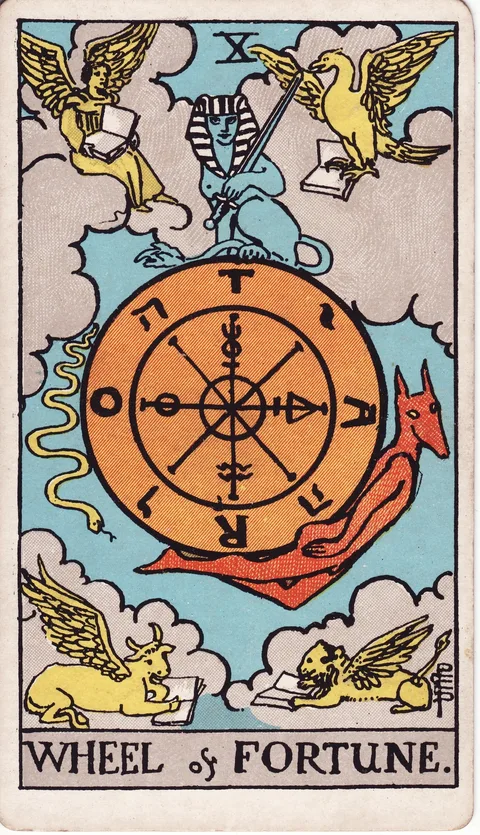 Inspect artwork
Upright meaning #
Upright, notice what is changing and distinguish an opening from a guarantee. A familiar cycle may be reaching a new phase. The useful response is to remain observant and prepare for movement, while recognizing the role of timing and circumstances beyond personal effort.
Reversed interpretation #
Reversed, consider resistance to a changed situation or a pattern that keeps repeating without being examined. It can also describe a setback within a larger process. Avoid treating a difficult turn as punishment or proof of bad karma.
RWS imagery and symbolism #
Smith’s wheel is surrounded by symbolic creatures and figures, while the corner beings hold books. The rotating center contrasts with the more stable corners. The image can support a question about what remains a useful reference while circumstances move.
A contextual reading example #
A project loses its original venue just as another space becomes available. In a situation position, the Wheel might frame the need to reassess changing conditions. The actual next step is checking the new space’s suitability, not assuming the disruption guarantees a better result.
Distinctions and limits #
The card is X, or 10. A modern numerological reading may reduce 1 + 0 to 1 while retaining the card’s cycle-completion meaning. That optional method does not make the Wheel identical to the Magician or establish anyone’s Life Path.
ACROSS TRADITIONS
Explore the connections
Optional correspondences within named systems. Each connection has its own context and source.
Sources & editorial notes
Original explanations and hypothetical examples prepared with AI assistance for Synergy. Sources document the traditions described; they do not establish predictive or causal validity.
Rider–Waite–Smith artwork by Pamela Colman Smith, public domain. Images are resized historical scans from Wikimedia Commons; the full card images retain their borders and original coloring. Image sources and credits.
- A. E. Waite, The Pictorial Key to the Tarot (1911), illustrated by Pamela Colman Smith
Part II, this card’s imagery; compare Part III for historical divinatory meanings. The reflective upright, reversal and reading examples here are original modern interpretations, not quotations from Waite.
Related tarot reading

Put it into practice
The daily reading uses 22 Major Arcana cards. A draw is not guaranteed to include the card you are studying.
Try Synergy’s daily one-card reading (Major Arcana only) →