On this page
AT A GLANCE
The Three of Swords concerns hurt, sorrow or a truth that is difficult to receive. It asks for honest acknowledgment rather than a quick positive spin. The card does not predict betrayal, a breakup or a medical problem.
Explore all 78 tarot cards →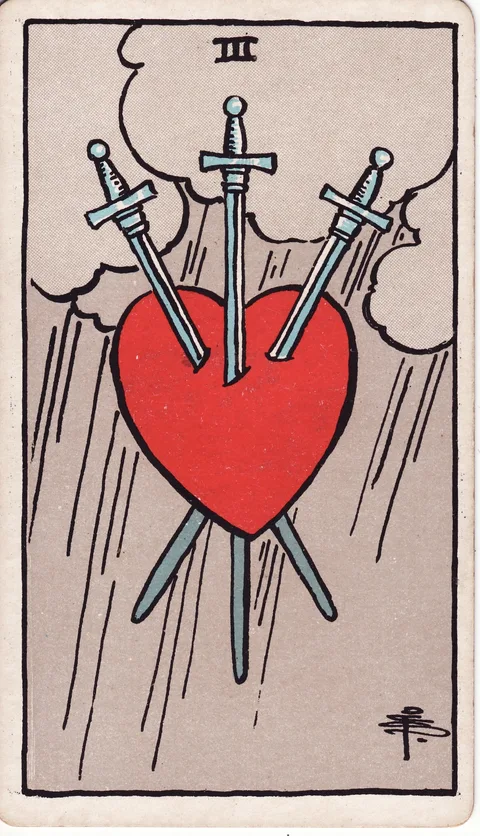 Inspect artwork
Upright meaning #
Upright, name the actual pain and distinguish the event from the story built around it. Clear recognition may be the beginning of a response, but it need not be rushed into a lesson. Support and practical care can matter more than interpretation.
Reversed interpretation #
Reversed, consider pain being processed, difficulty speaking about it or repeated rumination that keeps reopening the same wound. The possibilities depend on context. The card cannot decide how long grief or recovery should take.
RWS imagery and symbolism #
Three swords pierce a heart beneath rain clouds, without a human figure mediating the image. Its directness makes pain the central subject. The symbolism is striking, but a pictured heart is not an anatomical diagnosis or a factual account of a relationship.
A contextual reading example #
After hearing that a valued collaboration will end, a reader draws the Three in a situation position. It could acknowledge disappointment and the need to discuss a respectful ending. It should not be used to invent a secret betrayal behind the known news.
Distinctions and limits #
Do not treat the card as proof that another person intends harm. Golden Dawn assigns Saturn in Libra. A numerical theme of development cannot override the specific image; the rank alone is never the complete meaning.
ACROSS TRADITIONS
Explore the connections
Optional correspondences within named systems. Each connection has its own context and source.
Sources & editorial notes
Original explanations and hypothetical examples prepared with AI assistance for Synergy. Sources document the traditions described; they do not establish predictive or causal validity.
Rider–Waite–Smith artwork by Pamela Colman Smith, public domain. Images are resized historical scans from Wikimedia Commons; the full card images retain their borders and original coloring. Image sources and credits.
- A. E. Waite, The Pictorial Key to the Tarot (1911), illustrated by Pamela Colman Smith
Part III, Three of Swords: imagery and historical divinatory meanings. Contextual examples and reversal options are original modern reflective interpretations; historical gender stereotypes and predictive claims are not adopted.
Related tarot reading


Put it into practice
The daily reading uses 22 Major Arcana cards. A draw is not guaranteed to include the card you are studying.
Try Synergy’s daily one-card reading (Major Arcana only) →