On this page
AT A GLANCE
Jupiter represents expansion: learning more, seeking a larger perspective and trusting that possibilities exist. It is used to discuss meaning, teaching, generosity and opportunity. Expansion is not automatically improvement; taking on too much is also an intelligible Jupiter theme.
Explore planets and luminaries →
Place in the tradition #
Jupiter traditionally rules Sagittarius and Pisces. Modern practice often gives Pisces an additional Neptune rulership. Jupiter takes roughly twelve years to orbit the Sun, making its return a common symbolic marker of renewed growth, not a timetable for guaranteed success.
Reading the placement #
Jupiter’s sign can describe the style of growth and its house the field of opportunity or expectation. Jupiter in Virgo in the sixth house might frame learning through practical improvement. That combination does not erase limits: the rest of the chart and ordinary circumstances remain essential.
A practical example #
After discovering an interesting subject, a student enrolls in three courses. Jupiter’s enthusiasm opens a door, while a useful follow-up is deciding how much time can be given to each course. A generous aspiration becomes more useful when it has enough structure to be sustained.
Misconceptions and limits #
Traditional ‘benefic’ language describes a tendency in an astrological system, not protection from consequences. Jupiter placements do not justify financial risk or claims of moral superiority. Belief can orient action, but confidence is not evidence that a prediction is correct.
ACROSS TRADITIONS
Explore the connections
Optional correspondences within named systems. Each connection has its own context and source.
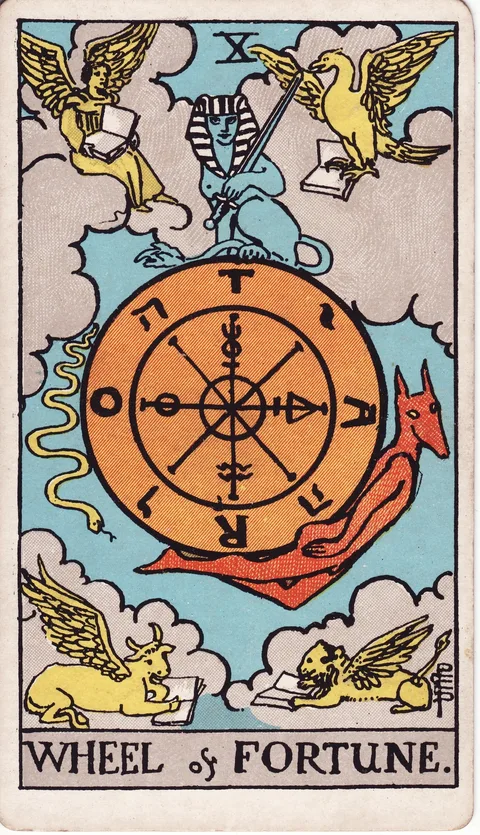
- tarot · Planetary attributionWheel of Fortune →
In Golden Dawn tarot, Jupiter is explicitly assigned to Wheel Of Fortune. This optional tarot correspondence is separate from interpreting Jupiter in an astrological chart.
Golden Dawn / Book T · Source
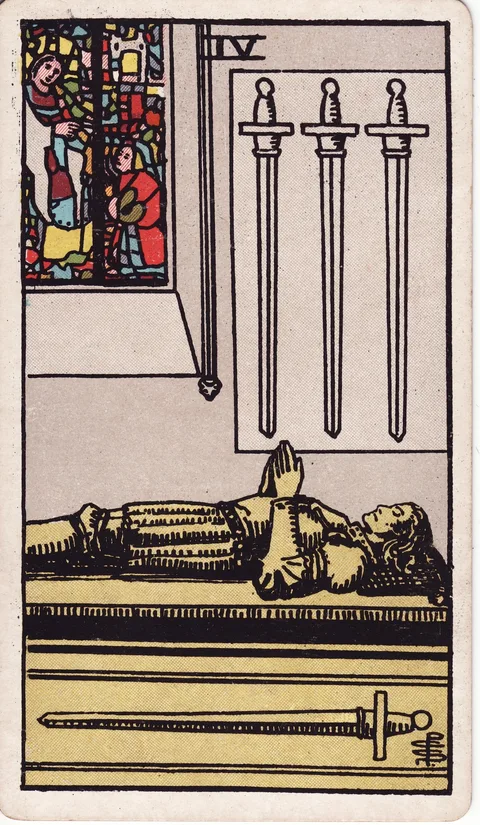
- tarot · Planetary decanFour of Swords →
Four Of Swords is assigned to Jupiter in Libra, the third decan of Libra, in Book T. The pairing explains this tarot association; it is separate from a natal placement or a personal numerology calculation.
Golden Dawn / Book T · Source
Sources & editorial notes
Original explanations and hypothetical examples prepared with AI assistance for Synergy. Sources document the traditions described; they do not establish predictive or causal validity.
Rider–Waite–Smith artwork by Pamela Colman Smith, public domain. Images are resized historical scans from Wikimedia Commons; the full card images retain their borders and original coloring. Image sources and credits.
- Ptolemy, Tetrabiblos, translated by J. M. Ashmand (1822)
Book I, chapters IV–VII and XX: traditional planetary categories and domiciles.
- Sepharial, Astrology: How to Make and Read Your Own Horoscope (1920 edition)
Section I, The Planets, their Natures and Types. Modern reflective examples here do not adopt historical deterministic claims.