On this page
AT A GLANCE
Judgement concerns taking stock of what has happened and responding to a clearer sense of what must change. It combines review with a decision to act differently. The card is not a supernatural verdict on a person’s worth or proof that a past choice can never be repaired.
Explore all 78 tarot cards →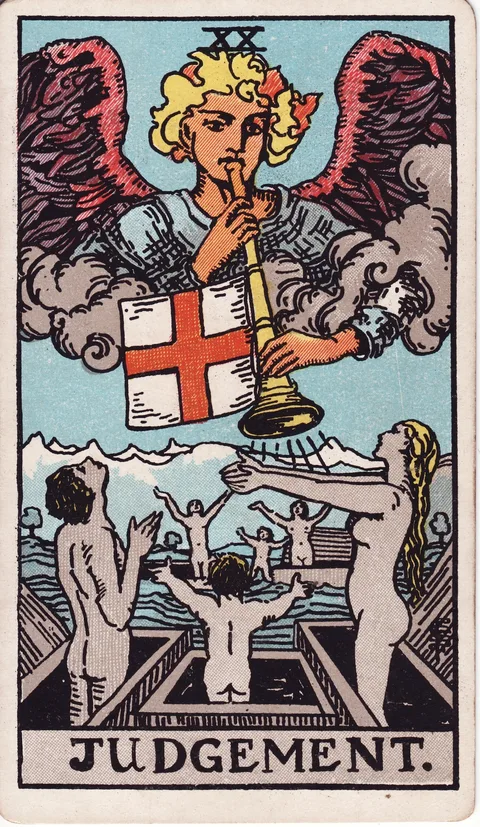 Inspect artwork
Upright meaning #
Upright, examine the pattern rather than only the latest event. A meaningful reassessment may lead to acknowledgment, repair or a new commitment. The emphasis differs from Justice’s weighing of a particular matter: Judgement often asks how a larger phase of life is being understood.
Reversed interpretation #
Reversed, consider avoiding a necessary review, harsh self-condemnation or waiting for outside permission to respond. A useful next step is separating responsibility for an action from a global judgment about yourself. Reflection should make a constructive response more possible.
RWS imagery and symbolism #
Smith depicts an angel sounding a trumpet above people rising from coffins. The resurrection imagery belongs to the deck’s religious vocabulary. In a reflective reading, it can frame awakening or response without requiring a literal belief in the scene.
A contextual reading example #
A team reviews a failed launch and identifies a repeated decision pattern. Judgement in the advice position could suggest acknowledging the pattern and changing how decisions are made. Blaming one person or promising to ‘do better’ without a new practice would leave the reassessment incomplete.
Distinctions and limits #
The card is XX, also spelled Judgment. Golden Dawn associates it with Fire and Spirit, not originally Pluto. The library uses the documented Fire connection and does not turn its religious imagery into a claim about reincarnation or divine approval.
ACROSS TRADITIONS
Explore the connections
Optional correspondences within named systems. Each connection has its own context and source.
Sources & editorial notes
Original explanations and hypothetical examples prepared with AI assistance for Synergy. Sources document the traditions described; they do not establish predictive or causal validity.
Rider–Waite–Smith artwork by Pamela Colman Smith, public domain. Images are resized historical scans from Wikimedia Commons; the full card images retain their borders and original coloring. Image sources and credits.
- A. E. Waite, The Pictorial Key to the Tarot (1911), illustrated by Pamela Colman Smith
Part II, this card’s imagery; compare Part III for historical divinatory meanings. Upright and reversed examples here are original reflective interpretations, not a transcription of Waite’s fortune-telling rules.
Related tarot reading

Put it into practice
The daily reading uses 22 Major Arcana cards. A draw is not guaranteed to include the card you are studying.
Try Synergy’s daily one-card reading (Major Arcana only) →