On this page
AT A GLANCE
The Nine of Swords concerns distressing thoughts, worry or the way a concern grows when faced alone. It invites care for the experience without treating the feared outcome as established. The card is not a diagnosis or a prediction that a nightmare will happen.
Explore all 78 tarot cards →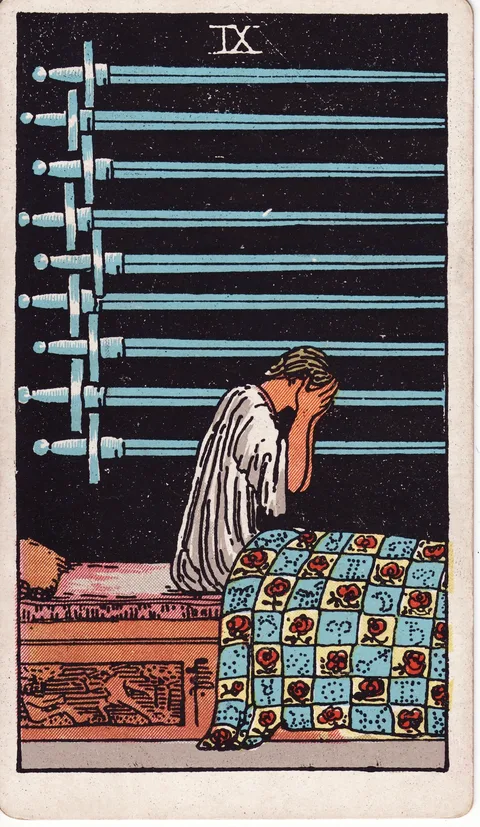 Inspect artwork
Upright meaning #
Upright, name the concern and distinguish what has occurred from what is being anticipated. Bringing a worry into a trusted conversation can help make it more specific. The immediate task may be support and rest rather than solving every possible future problem.
Reversed interpretation #
Reversed, consider a worry becoming speakable, persistent private distress or a gradual return of perspective. Do not assume that an inward problem is less serious because others cannot see it. A card cannot determine the appropriate level of care.
RWS imagery and symbolism #
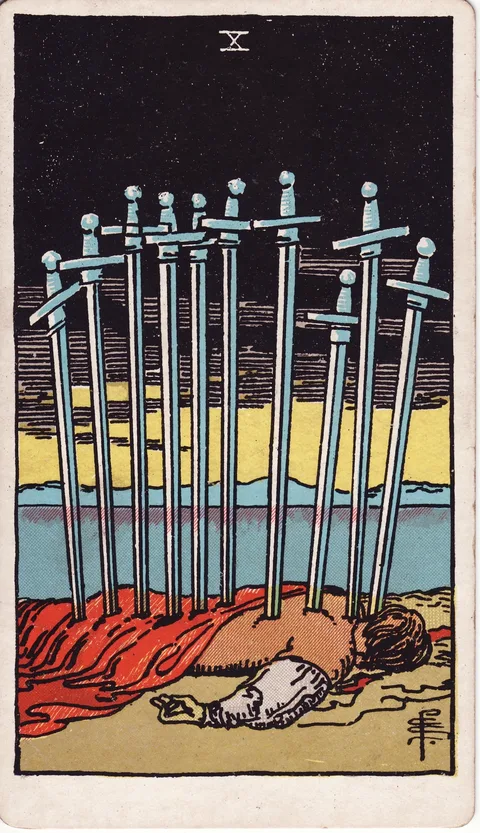
Smith shows a person sitting up in bed with their face in their hands, beneath nine swords. The scene centers the experience of distress rather than an external event. The setting makes isolation and nighttime thought especially visible.
A contextual reading example #
Before an important conversation, a reader imagines every possible negative response. The Nine in the situation position could name the spiral. A useful step is preparing a few clear points and talking with someone trusted, rather than treating imagined responses as facts.
Distinctions and limits #
The card should not be used to diagnose depression, anxiety or another condition. Golden Dawn assigns Mars in Gemini. If distress is ongoing, actual support matters more than repeated card draws seeking certainty.
ACROSS TRADITIONS
Explore the connections
Optional correspondences within named systems. Each connection has its own context and source.
Sources & editorial notes
Original explanations and hypothetical examples prepared with AI assistance for Synergy. Sources document the traditions described; they do not establish predictive or causal validity.
Rider–Waite–Smith artwork by Pamela Colman Smith, public domain. Images are resized historical scans from Wikimedia Commons; the full card images retain their borders and original coloring. Image sources and credits.
- A. E. Waite, The Pictorial Key to the Tarot (1911), illustrated by Pamela Colman Smith
Part III, Nine of Swords: imagery and historical divinatory meanings. Contextual examples and reversal options are original modern reflective interpretations; historical gender stereotypes and predictive claims are not adopted.
Related tarot reading

Put it into practice
The daily reading uses 22 Major Arcana cards. A draw is not guaranteed to include the card you are studying.
Try Synergy’s daily one-card reading (Major Arcana only) →