On this page
AT A GLANCE
The Ten of Swords concerns a point at which a line of effort or expectation has reached an unmistakable ending. It can symbolize defeat, finality or the need to stop reopening a concluded matter. Its dramatic image does not predict literal violence or death.
Explore all 78 tarot cards →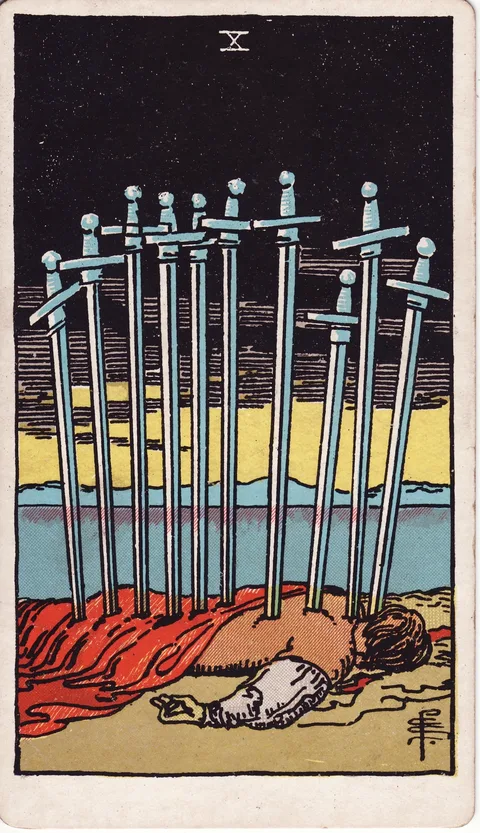 Inspect artwork
Upright meaning #
Upright, identify what can no longer continue in the same form. The useful action may be closure and practical care rather than another attempt to win. Acknowledging finality can preserve resources for what remains possible elsewhere.
Reversed interpretation #
Reversed, consider gradual recovery, difficulty accepting an ending or a situation that is changing but not yet settled. Avoid promising an immediate rebound. The next step may be modest and concrete, such as completing a handover or ending an unproductive exchange.
RWS imagery and symbolism #
A prone figure lies beneath ten swords under a dark sky, with a brighter horizon beyond. The image exaggerates finality, while the distant light leaves space beyond the depicted moment. That space is not a guarantee of a particular happy outcome.
A contextual reading example #
After a proposal has been conclusively rejected, the Ten as advice could suggest ending repeated appeals, preserving the useful work and deciding where to apply it next. It would not justify assuming that every future proposal will meet the same response.
Distinctions and limits #
The printed rank is 10. Reducing it to 1 is optional and must not erase the ending. Golden Dawn assigns Sun in Gemini. Do not use the card to forecast injury or tell someone their life is ruined.
ACROSS TRADITIONS
Explore the connections
Optional correspondences within named systems. Each connection has its own context and source.
Sources & editorial notes
Original explanations and hypothetical examples prepared with AI assistance for Synergy. Sources document the traditions described; they do not establish predictive or causal validity.
Rider–Waite–Smith artwork by Pamela Colman Smith, public domain. Images are resized historical scans from Wikimedia Commons; the full card images retain their borders and original coloring. Image sources and credits.
- A. E. Waite, The Pictorial Key to the Tarot (1911), illustrated by Pamela Colman Smith
Part III, Ten of Swords: imagery and historical divinatory meanings. Contextual examples and reversal options are original modern reflective interpretations; historical gender stereotypes and predictive claims are not adopted.
Related tarot reading

Put it into practice
The daily reading uses 22 Major Arcana cards. A draw is not guaranteed to include the card you are studying.
Try Synergy’s daily one-card reading (Major Arcana only) →