On this page
AT A GLANCE
The Nine of Cups concerns personal satisfaction and the pleasure of something wanted becoming available. It invites recognition of enjoyment without making it the final measure of a good life. The familiar ‘wish card’ label is not a guarantee that any wish will be granted.
Explore all 78 tarot cards →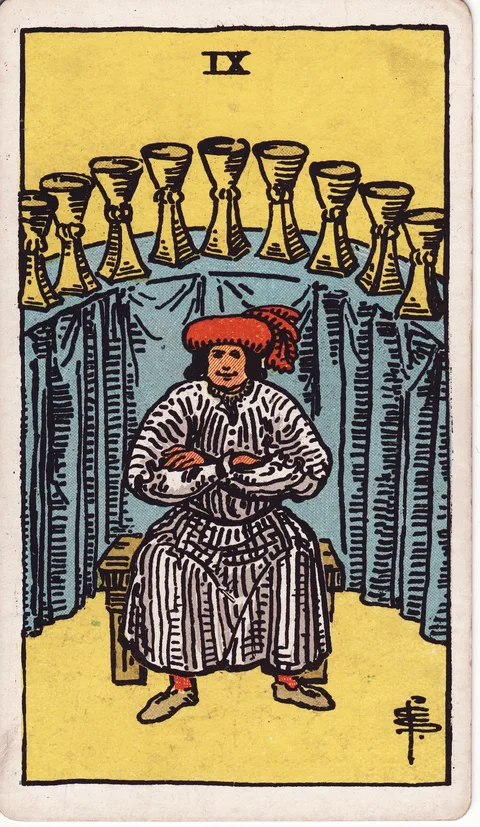 Inspect artwork
Upright meaning #
Upright, notice what is already satisfying and allow an achievement or pleasure to register. A reader may need to stop moving the goalposts long enough to appreciate a result. Ask what enough feels like in concrete terms.
Reversed interpretation #
Reversed, consider an achievement that does not satisfy, pleasure becoming excessive or a wish borrowed from someone else’s expectations. The next question is not necessarily how to obtain more, but whether the desired outcome matches the underlying need.
RWS imagery and symbolism #
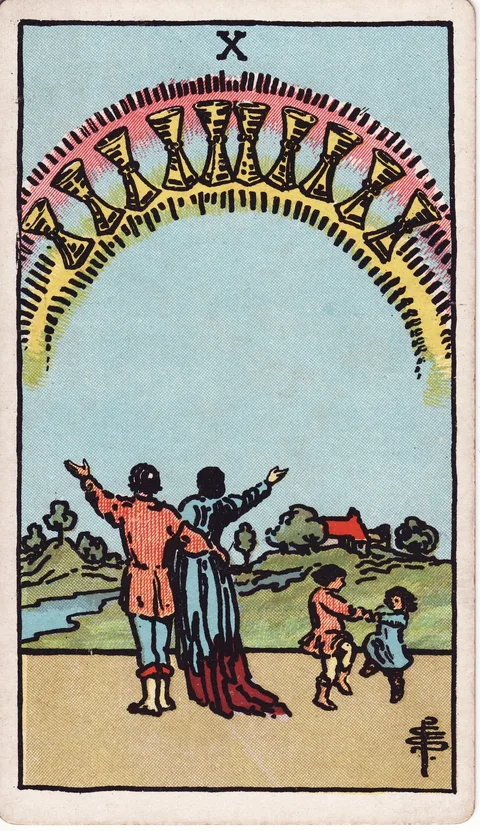
A seated figure appears before a curved arrangement of nine cups, with arms folded and a composed expression. The display suggests possession or enjoyment, while the individual figure distinguishes the scene from the communal Ten of Cups.
A contextual reading example #
After receiving a long-sought qualification, a reader draws the Nine in a reflection position. It could invite enjoying the accomplishment and noticing which parts actually feel meaningful. If satisfaction is absent, the card can open inquiry rather than demand gratitude.
Distinctions and limits #
Pleasure is not selfish by definition, but it does not remove other responsibilities. Golden Dawn associates the Nine with Jupiter in Pisces. A card cannot promise material reward or establish that a desired person will reciprocate affection.
ACROSS TRADITIONS
Explore the connections
Optional correspondences within named systems. Each connection has its own context and source.
Sources & editorial notes
Original explanations and hypothetical examples prepared with AI assistance for Synergy. Sources document the traditions described; they do not establish predictive or causal validity.
Rider–Waite–Smith artwork by Pamela Colman Smith, public domain. Images are resized historical scans from Wikimedia Commons; the full card images retain their borders and original coloring. Image sources and credits.
- A. E. Waite, The Pictorial Key to the Tarot (1911), illustrated by Pamela Colman Smith
Part III, Nine of Cups: imagery and historical divinatory meanings. Contextual examples and reversal options are original modern reflective interpretations; historical gender stereotypes and predictive claims are not adopted.
Related tarot reading

Put it into practice
The daily reading uses 22 Major Arcana cards. A draw is not guaranteed to include the card you are studying.
Try Synergy’s daily one-card reading (Major Arcana only) →