On this page
AT A GLANCE
Death most often concerns an ending, a substantial transition or the need to stop preserving a form that no longer works. Its stark image makes finality difficult to ignore. It is not a reliable prediction of literal death.
Explore all 78 tarot cards →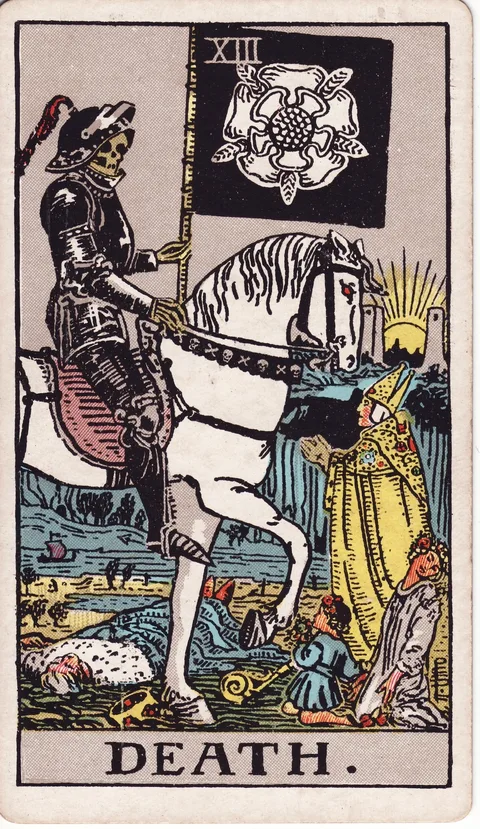 Inspect artwork
Upright meaning #
Upright, identify what is actually ending and what needs to be acknowledged before a new arrangement can take shape. Change can involve grief even when it is welcome. The card differs from the Tower’s sudden disruption by emphasizing an irreversible passage from one form to another.
Reversed interpretation #
Reversed, consider clinging to an exhausted arrangement, a delayed ending or difficulty allowing a transition to be real. It may also suggest a quieter internal change. The interpretation should follow the question and known circumstances rather than demanding dramatic upheaval.
RWS imagery and symbolism #
A skeleton in armor rides a white horse, carrying a black banner with a white flower. Figures of different social positions encounter the rider, and a light appears between distant towers. The imagery emphasizes that endings cross status boundaries while continuity takes another form.
A contextual reading example #
After a project has fulfilled its purpose, Death in an action position could suggest formally closing it, preserving useful records and releasing commitments. It would not mean destroying every connection to the work. Ending well can be a practical, respectful task.
Distinctions and limits #
Do not use this card to forecast mortality, illness or disaster. It is XIII in RWS and has a Golden Dawn Scorpio attribution. The modern word ‘transformation’ should not erase the real sadness or practical work that an ending may involve.
ACROSS TRADITIONS
Explore the connections
Optional correspondences within named systems. Each connection has its own context and source.
Sources & editorial notes
Original explanations and hypothetical examples prepared with AI assistance for Synergy. Sources document the traditions described; they do not establish predictive or causal validity.
Rider–Waite–Smith artwork by Pamela Colman Smith, public domain. Images are resized historical scans from Wikimedia Commons; the full card images retain their borders and original coloring. Image sources and credits.
- A. E. Waite, The Pictorial Key to the Tarot (1911), illustrated by Pamela Colman Smith
Part II, this card’s imagery; compare Part III for historical divinatory meanings. Upright and reversed examples here are original reflective interpretations, not a transcription of Waite’s fortune-telling rules.
Related tarot reading

Put it into practice
The daily reading uses 22 Major Arcana cards. A draw is not guaranteed to include the card you are studying.
Try Synergy’s daily one-card reading (Major Arcana only) →