On this page
AT A GLANCE
The King of Cups concerns remaining responsive while holding a steady position amid changing feelings or demands. It can describe diplomacy, mature care or responsible use of emotional influence. Calm appearance alone does not establish emotional wisdom.
Explore all 78 tarot cards →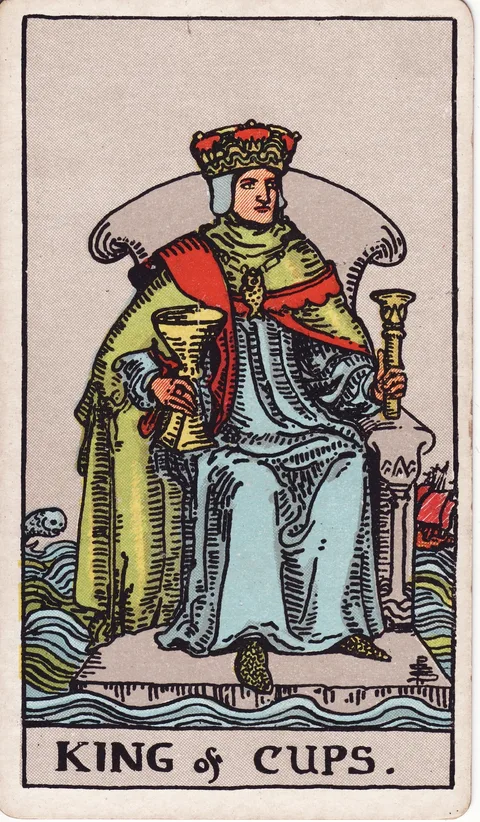 Inspect artwork
Upright meaning #
Upright, acknowledge feeling without letting every fluctuation dictate the next action. The King’s task is to create enough steadiness for a situation to be addressed. In leadership, this includes making room for others’ experience rather than merely maintaining composure.
Reversed interpretation #
Reversed, consider emotions controlled too tightly, influence used to manage others or a calm surface hiding unresolved strain. These are questions to examine, not accusations. The practical response may be clearer communication or a more honest acknowledgment of limits.
RWS imagery and symbolism #
Smith places a seated king on a throne surrounded by moving water, with a cup and scepter in hand. A ship and a sea creature appear nearby. The scene makes steadiness within movement more important than escape from the emotional environment.
A contextual reading example #
In a tense group discussion, the King in an advice position could suggest naming the shared concern, acknowledging feelings and keeping the conversation focused on a workable decision. It would not mean dismissing upset people as irrational.
Distinctions and limits #
The card is not restricted to men or to a profession such as counselor. A court card can represent an approach you practice. Emotional steadiness should not be confused with suppressing disagreement or taking responsibility for everyone’s mood.
Sources & editorial notes
Original explanations and hypothetical examples prepared with AI assistance for Synergy. Sources document the traditions described; they do not establish predictive or causal validity.
Rider–Waite–Smith artwork by Pamela Colman Smith, public domain. Images are resized historical scans from Wikimedia Commons; the full card images retain their borders and original coloring. Image sources and credits.
- A. E. Waite, The Pictorial Key to the Tarot (1911), illustrated by Pamela Colman Smith
Part III, King of Cups: imagery and historical divinatory meanings. Contextual examples and reversal options are original modern reflective interpretations; historical gender stereotypes and predictive claims are not adopted.
Related tarot reading

Put it into practice
The daily reading uses 22 Major Arcana cards. A draw is not guaranteed to include the card you are studying.
Try Synergy’s daily one-card reading (Major Arcana only) →