On this page
AT A GLANCE
The Queen of Swords concerns clear perception, honest language and boundaries informed by experience. It can suggest listening carefully while refusing to blur an important distinction. Directness need not become cruelty, and compassion need not require agreement.
Explore all 78 tarot cards →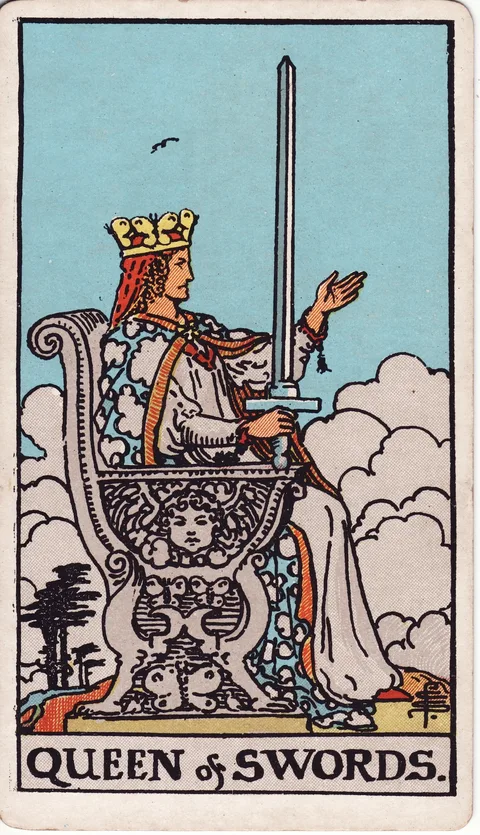 Inspect artwork
Upright meaning #
Upright, say what is true enough to act on and identify the terms under which you will participate. The Queen can support thoughtful independence: considering another view without surrendering judgment. Experience becomes useful when it sharpens understanding rather than hardens a stereotype.
Reversed interpretation #
Reversed, consider cutting speech, guardedness or self-doubt that makes a boundary difficult to state. It may ask for a clearer distinction between a fact and an old expectation. The card should not be used to label a woman cold or embittered.
RWS imagery and symbolism #
Smith’s queen holds an upright sword while extending her other hand. The gesture combines a clear boundary with an opening for communication. Clouds and the elevated throne reinforce the suit’s emphasis on perspective and thought.
A contextual reading example #
In a reading about an uneven collaboration, the Queen as advice could mean naming the missing contribution and stating what must change for the work to continue. The message can be specific and respectful without disguising the consequence.
Distinctions and limits #
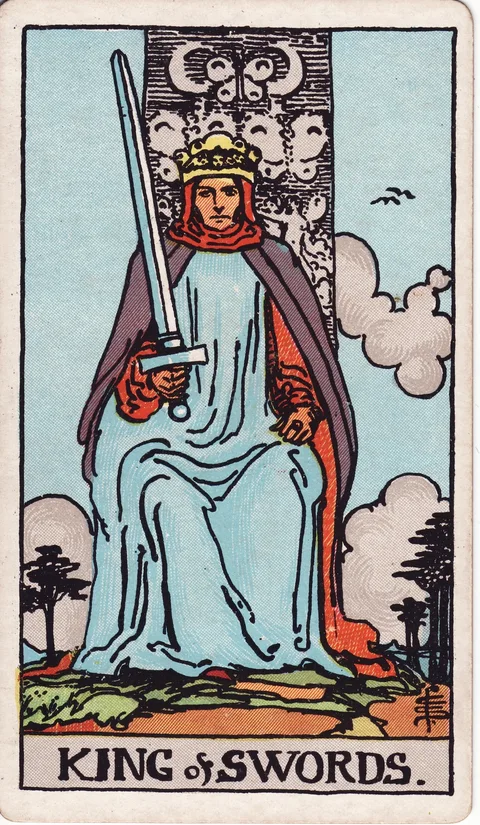
The Queen is not a prediction of widowhood or a fixed gender role, despite historical fortune-telling conventions. Read her alongside the King of Swords for the distinction between discerning engagement and broader responsibility for a decision.
Sources & editorial notes
Original explanations and hypothetical examples prepared with AI assistance for Synergy. Sources document the traditions described; they do not establish predictive or causal validity.
Rider–Waite–Smith artwork by Pamela Colman Smith, public domain. Images are resized historical scans from Wikimedia Commons; the full card images retain their borders and original coloring. Image sources and credits.
- A. E. Waite, The Pictorial Key to the Tarot (1911), illustrated by Pamela Colman Smith
Part III, Queen of Swords: imagery and historical divinatory meanings. Contextual examples and reversal options are original modern reflective interpretations; historical gender stereotypes and predictive claims are not adopted.
Related tarot reading

Put it into practice
The daily reading uses 22 Major Arcana cards. A draw is not guaranteed to include the card you are studying.
Try Synergy’s daily one-card reading (Major Arcana only) →