On this page
AT A GLANCE
The Page of Pentacles concerns beginning a practical study or skill with focused attention. It can represent an offer to learn, a useful resource or a beginner’s approach. The emphasis is on handling something real rather than only imagining the result.
Explore all 78 tarot cards →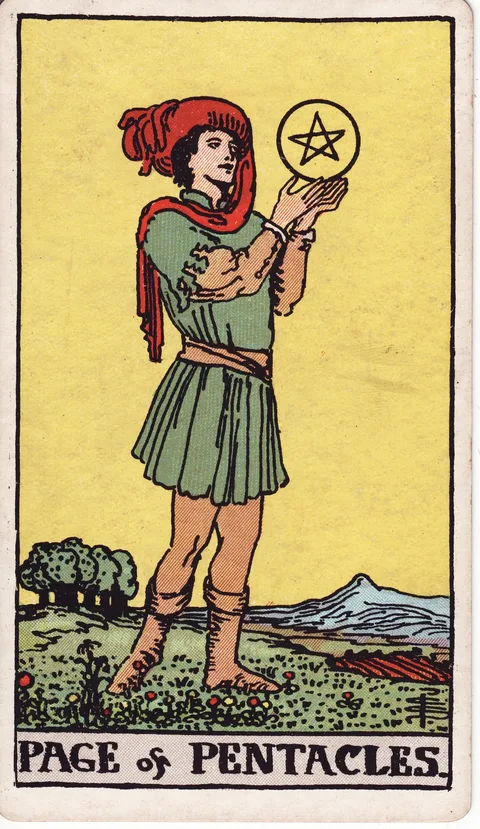 Inspect artwork
Upright meaning #
Upright, choose a small task through which progress can be observed. Read the instructions, practice the basics and ask for feedback. The Page’s seriousness is useful when it supports curiosity rather than fear of making a first mistake.
Reversed interpretation #
Reversed, consider collecting plans without practice, distraction from the basics or discouragement at a slow beginning. It may ask for a clearer routine or a more suitable learning resource. A delayed start does not establish lack of ability.
RWS imagery and symbolism #
A standing figure studies a pentacle held in both hands within an open landscape. Attention rests on the object, while the fields suggest room for development. The scene presents a learner’s concentration rather than the King’s established stewardship.
A contextual reading example #
In a reading about learning bookkeeping, the Page as advice could mean working through one simple example and checking each entry before expanding the task. The card is not a reason to make a financial commitment beyond the learner’s understanding.
Distinctions and limits #
Pages are not restricted to children or a particular gender. Read the court as a role before deciding it names someone. This library does not assign a personal numerology number from the Page’s position in a deck.
Sources & editorial notes
Original explanations and hypothetical examples prepared with AI assistance for Synergy. Sources document the traditions described; they do not establish predictive or causal validity.
Rider–Waite–Smith artwork by Pamela Colman Smith, public domain. Images are resized historical scans from Wikimedia Commons; the full card images retain their borders and original coloring. Image sources and credits.
- A. E. Waite, The Pictorial Key to the Tarot (1911), illustrated by Pamela Colman Smith
Part III, Page of Pentacles: imagery and historical divinatory meanings. Contextual examples and reversal options are original modern reflective interpretations; historical gender stereotypes and predictive claims are not adopted.
Related tarot reading

Put it into practice
The daily reading uses 22 Major Arcana cards. A draw is not guaranteed to include the card you are studying.
Try Synergy’s daily one-card reading (Major Arcana only) →