On this page
AT A GLANCE
The Two of Swords concerns a decision held in suspension, often while competing considerations remain difficult to reconcile. It can suggest a temporary boundary or stalemate. The question is whether the pause protects clear judgment or prevents engagement with information already available.
Explore all 78 tarot cards →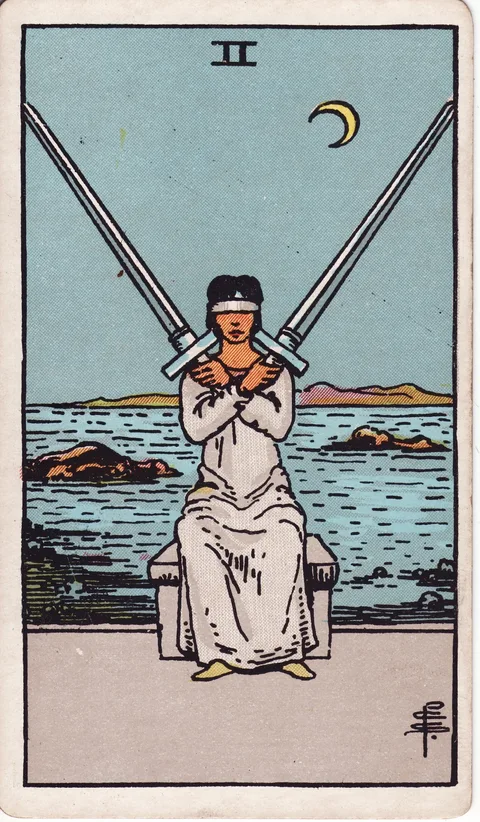 Inspect artwork
Upright meaning #
Upright, identify the alternatives and what is needed to compare them. Neutrality can be useful for a time, but declining to choose may also have consequences. Name the decision rather than treating unease as an indefinite reason to delay it.
Reversed interpretation #
Reversed, consider information breaking through, overload or a choice made simply to escape discomfort. Ask whether new clarity is genuine. A decision can be provisional when the conditions for reviewing it are explicit.
RWS imagery and symbolism #
A blindfolded figure holds two crossed swords before water under a crescent Moon. The posture creates a guarded balance. The blindfold invites questions about limited information or deliberate exclusion, but it does not tell the viewer which explanation applies.
A contextual reading example #
A reader avoiding a conversation about workload draws the Two as advice. It could suggest listing the competing needs, gathering missing facts and setting a time to discuss them. The card would not recommend silence as the permanent solution.
Distinctions and limits #
The Two does not prove dishonesty or inability to decide. Its Golden Dawn correspondence is Moon in Libra. Compare the Seven of Cups, where the problem is a field of imagined options rather than this more tightly held stalemate.
ACROSS TRADITIONS
Explore the connections
Optional correspondences within named systems. Each connection has its own context and source.
Sources & editorial notes
Original explanations and hypothetical examples prepared with AI assistance for Synergy. Sources document the traditions described; they do not establish predictive or causal validity.
Rider–Waite–Smith artwork by Pamela Colman Smith, public domain. Images are resized historical scans from Wikimedia Commons; the full card images retain their borders and original coloring. Image sources and credits.
- A. E. Waite, The Pictorial Key to the Tarot (1911), illustrated by Pamela Colman Smith
Part III, Two of Swords: imagery and historical divinatory meanings. Contextual examples and reversal options are original modern reflective interpretations; historical gender stereotypes and predictive claims are not adopted.
Related tarot reading

Put it into practice
The daily reading uses 22 Major Arcana cards. A draw is not guaranteed to include the card you are studying.
Try Synergy’s daily one-card reading (Major Arcana only) →