On this page
AT A GLANCE
The Page of Wands concerns exploratory enthusiasm: approaching an idea as a learner and discovering what might be possible. It can represent a person, a message or a way of engaging. It is not restricted to a young person or a particular gender.
Explore all 78 tarot cards →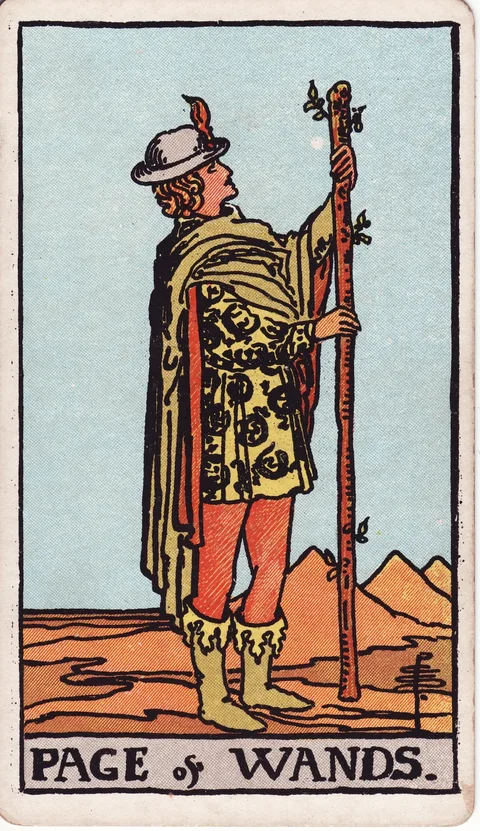 Inspect artwork
Upright meaning #
Upright, let curiosity become a small experiment. Ask questions, try a technique and notice what holds your attention. The Page is less concerned with mastery than with the willingness to engage before a confident identity has formed.
Reversed interpretation #
Reversed, consider scattered excitement, fear of looking inexperienced or a promising idea that never gets a practical outlet. The helpful response may be a smaller exercise and clearer feedback. A beginning does not need to prove exceptional talent.
RWS imagery and symbolism #
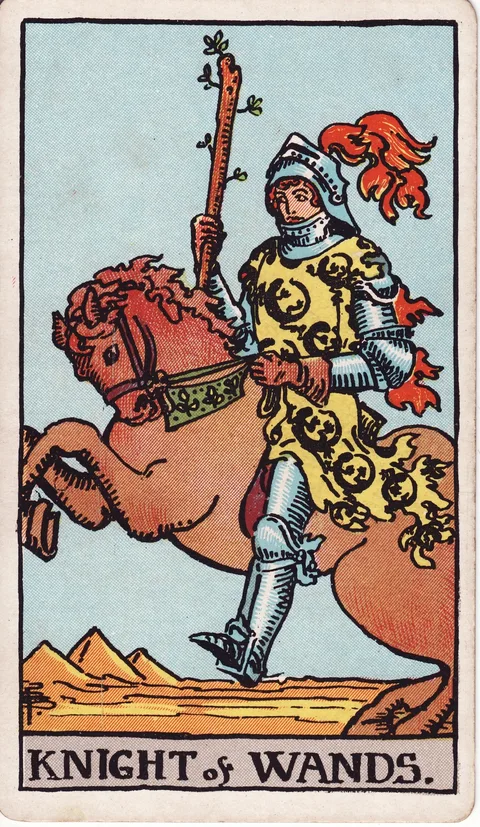
A standing figure studies a sprouting wand in a dry landscape, wearing clothing decorated with salamander imagery. Attention rests on the wand rather than a crowd or destination. The scene suggests discovering the possibilities of the suit’s creative tool.
A contextual reading example #
In a reading about learning public speaking, the Page as advice could suggest joining a low-pressure practice session and trying one short story. It would not promise a career on stage. The value lies in learning from participation.
Distinctions and limits #
Read court cards as roles or approaches before assigning them to people. Golden Dawn court titles do not map neatly by name onto RWS courts, so this library does not invent a natal sign or personal number for the Page.
Sources & editorial notes
Original explanations and hypothetical examples prepared with AI assistance for Synergy. Sources document the traditions described; they do not establish predictive or causal validity.
Rider–Waite–Smith artwork by Pamela Colman Smith, public domain. Images are resized historical scans from Wikimedia Commons; the full card images retain their borders and original coloring. Image sources and credits.
- A. E. Waite, The Pictorial Key to the Tarot (1911), illustrated by Pamela Colman Smith
Part III, Page of Wands: imagery and historical divinatory meanings. Contextual examples and reversal options are original modern reflective interpretations; historical gender stereotypes and predictive claims are not adopted.
Related tarot reading

Put it into practice
The daily reading uses 22 Major Arcana cards. A draw is not guaranteed to include the card you are studying.
Try Synergy’s daily one-card reading (Major Arcana only) →