On this page
AT A GLANCE
The Emperor concerns structures that make action durable: boundaries, responsibilities and clear authority. It can ask who decides, what rules apply and whether those rules serve their purpose. Authority should be evaluated by its conduct, not presumed legitimate because the card appears.
Explore all 78 tarot cards →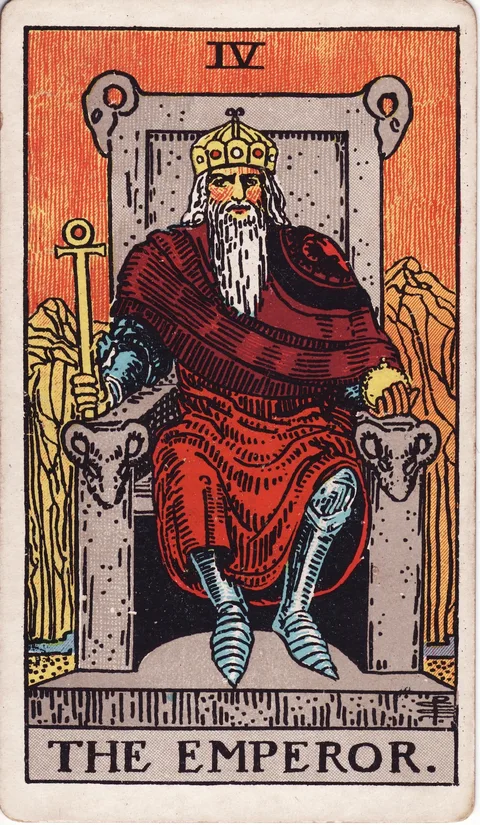 Inspect artwork
Upright meaning #
Upright, organize what needs to be stable. Define ownership, make expectations explicit and distinguish a firm boundary from a personal demand. The card can describe a role you take or a structure you encounter, rather than a particular man or father.
Reversed interpretation #
Reversed, consider rigidity, unaccountable control or the absence of a workable structure. The response depends on which problem is real. An overregulated process may need room for judgment; a chaotic collaboration may need a clear decision-maker and a way to challenge decisions.
RWS imagery and symbolism #
Smith’s ruler sits on a stone throne decorated with ram heads, holding symbols of office and wearing armor beneath his robes. Mountains reinforce the image of firmness. The armor can suggest protection while also inviting a question about how much defensiveness the role requires.
A contextual reading example #
In a shared project, the Emperor in an advice position could mean writing down responsibilities and agreeing how disputes will be handled. It would not mean one participant should dominate. In a challenge position, it could ask whether the current rules prevent useful work.
Distinctions and limits #
The Emperor is IV in RWS. Its Aries correspondence does not establish a link between Aries and Life Path 4. A number reading of the card and a zodiac correspondence are separate methods, and neither authorizes coercion.
ACROSS TRADITIONS
Explore the connections
Optional correspondences within named systems. Each connection has its own context and source.
- numerology · Optional numerical readingNumber 4 →
The printed number is IV, or 4. Numerological approaches to tarot can add this general number vocabulary to the image. An original reflection prompt here is structure and its limits. This is not a Life Path calculation.
Modern numerological tarot; RWS numbering · Source
Sources & editorial notes
Original explanations and hypothetical examples prepared with AI assistance for Synergy. Sources document the traditions described; they do not establish predictive or causal validity.
Rider–Waite–Smith artwork by Pamela Colman Smith, public domain. Images are resized historical scans from Wikimedia Commons; the full card images retain their borders and original coloring. Image sources and credits.
- A. E. Waite, The Pictorial Key to the Tarot (1911), illustrated by Pamela Colman Smith
Part II, this card’s imagery; compare Part III for historical divinatory meanings. The reflective upright, reversal and reading examples here are original modern interpretations, not quotations from Waite.
Related tarot reading

Put it into practice
The daily reading uses 22 Major Arcana cards. A draw is not guaranteed to include the card you are studying.
Try Synergy’s daily one-card reading (Major Arcana only) →