On this page
AT A GLANCE
Justice concerns fair assessment, responsibility and the relationship between choices and consequences. It asks what the evidence supports and whether a process is equitable. The card does not guarantee that an institution will act fairly or that a legal dispute will end in your favor.
Explore all 78 tarot cards →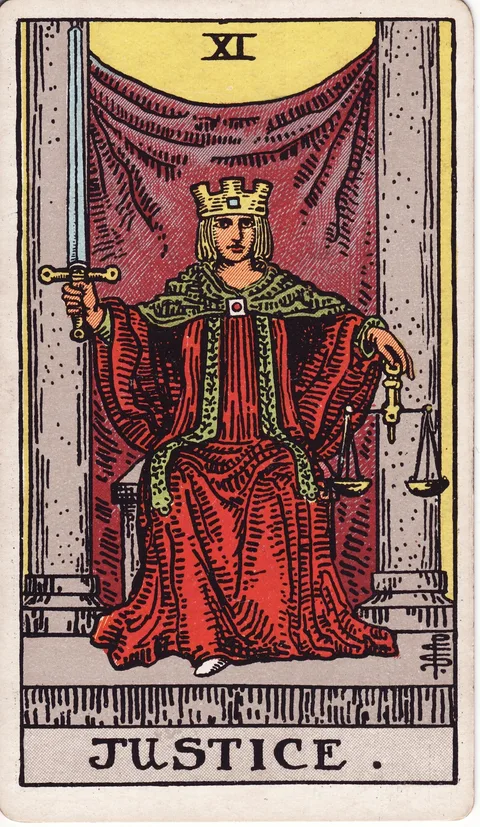 Inspect artwork
Upright meaning #
Upright, examine terms, facts and your own contribution. A decision may require consistency rather than preference. The card can prompt transparent agreements and a willingness to correct an error, not merely confidence that you are on the right side.
Reversed interpretation #
Reversed, consider bias, incomplete information or avoidance of accountability. It may ask whether the rules are applied unevenly. Do not infer guilt from the card; identify what can actually be documented and what remains an allegation.
RWS imagery and symbolism #
Smith’s seated figure holds balanced scales and an upright sword between pillars. The scales suggest weighing, while the sword suggests a clear distinction or decision. The image holds deliberation and action together rather than reducing fairness to a pleasant outcome.
A contextual reading example #
In a dispute about shared expenses, Justice in an advice position could suggest reviewing the original agreement and checking the figures together. The practical task is a transparent process. The card cannot determine legal rights or replace qualified advice about an actual legal issue.
Distinctions and limits #
Justice is XI in RWS, but commonly VIII in Marseille. The Golden Dawn assigns it to Libra. A numerical reading must respect the deck’s numbering; neither XI nor Libra establishes a connection to someone’s personal master number 11.
ACROSS TRADITIONS
Explore the connections
Optional correspondences within named systems. Each connection has its own context and source.
- numerology · Optional numerical readingNumber 2 →
RWS Justice is XI: 11 reduces as 1 + 1 = 2 in this optional method. Numerological approaches to tarot can add this general number vocabulary to the image. An original reflection prompt here is two sides of an assessment. This is not a Life Path calculation; this reduction does not preserve numerology's master 11.
Modern numerological tarot; RWS numbering · Source
Sources & editorial notes
Original explanations and hypothetical examples prepared with AI assistance for Synergy. Sources document the traditions described; they do not establish predictive or causal validity.
Rider–Waite–Smith artwork by Pamela Colman Smith, public domain. Images are resized historical scans from Wikimedia Commons; the full card images retain their borders and original coloring. Image sources and credits.
- A. E. Waite, The Pictorial Key to the Tarot (1911), illustrated by Pamela Colman Smith
Part II, this card’s imagery; compare Part III for historical divinatory meanings. Upright and reversed examples here are original reflective interpretations, not a transcription of Waite’s fortune-telling rules.
Related tarot reading

Put it into practice
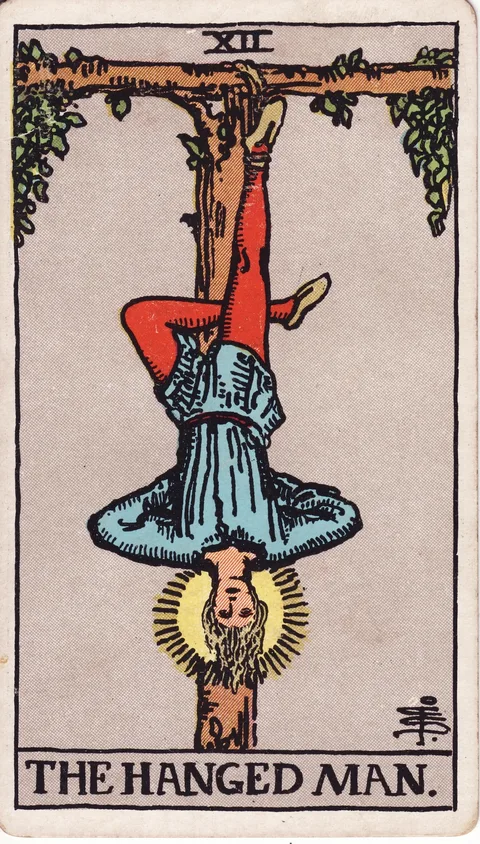
The daily reading uses 22 Major Arcana cards. A draw is not guaranteed to include the card you are studying.
Try Synergy’s daily one-card reading (Major Arcana only) →