On this page
AT A GLANCE
The Ace of Pentacles concerns a practical opening: a resource, skill or opportunity that can be developed into something useful. It asks what conditions would let potential take root. It is not a promise of money or a recommendation to invest.
Explore all 78 tarot cards →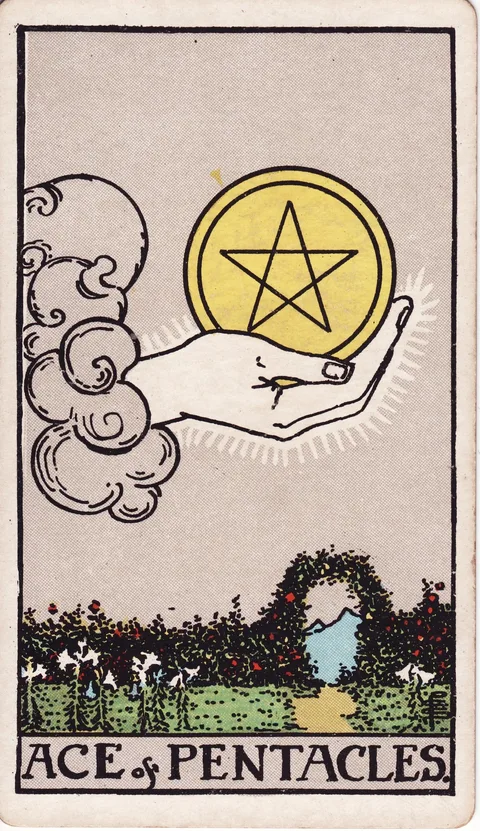 Inspect artwork
Upright meaning #
Upright, identify the concrete offer and the work needed to use it. A small beginning may have value precisely because it is manageable. Pentacles emphasize material conditions, so time, tools, access and maintenance matter alongside enthusiasm.
Reversed interpretation #
Reversed, consider an opportunity with unclear terms, a start delayed by resources or a useful seed being neglected. The response may be checking feasibility rather than forcing progress. An attractive offer is not automatically a sound one.
RWS imagery and symbolism #
A hand presents a pentacle above a cultivated garden with an opening toward a path. The image combines a gift-like possibility with a setting that has already required care. The offered object does not show a completed outcome.
A contextual reading example #
In a reading about learning a trade, the Ace as advice could suggest obtaining one suitable tool and committing to a short course. The useful question is whether the first step supports actual practice. It would not justify buying expensive equipment before understanding the task.
Distinctions and limits #
The Ace is rank 1 in numerical readings and Earth in the Golden Dawn elemental scheme. It differs from the Nine’s developed self-sufficiency and the Ten’s shared long-term resources. Potential still requires real conditions.
ACROSS TRADITIONS
Explore the connections
Optional correspondences within named systems. Each connection has its own context and source.
Sources & editorial notes
Original explanations and hypothetical examples prepared with AI assistance for Synergy. Sources document the traditions described; they do not establish predictive or causal validity.
Rider–Waite–Smith artwork by Pamela Colman Smith, public domain. Images are resized historical scans from Wikimedia Commons; the full card images retain their borders and original coloring. Image sources and credits.
- A. E. Waite, The Pictorial Key to the Tarot (1911), illustrated by Pamela Colman Smith
Part III, Ace of Pentacles: imagery and historical divinatory meanings. Contextual examples and reversal options are original modern reflective interpretations; historical gender stereotypes and predictive claims are not adopted.
Related tarot reading
Pentacles
The suit of resources, craft, practical care and the conditions that sustain everyday life.
Interpreting tarot cards together
Combine positions, repeated motifs and contrasts without turning a spread into an arbitrary story.
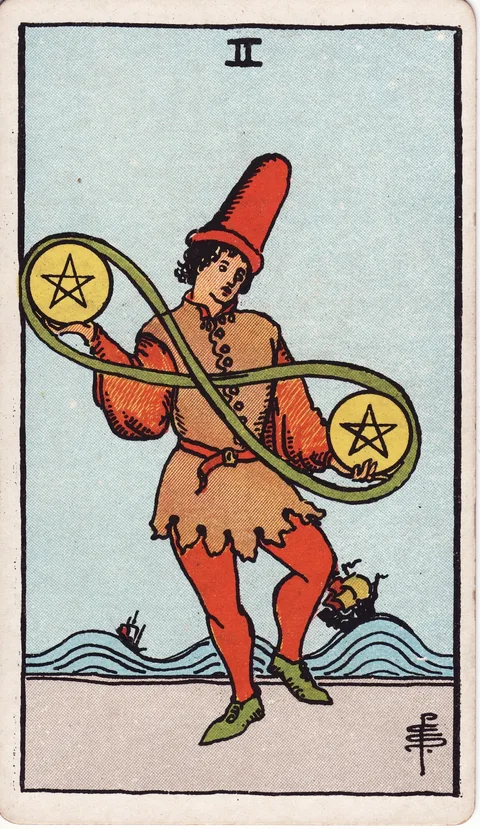
Two of Pentacles
Managing changing demands without losing the essentials

Put it into practice
The daily reading uses 22 Major Arcana cards. A draw is not guaranteed to include the card you are studying.
Try Synergy’s daily one-card reading (Major Arcana only) →