On this page
AT A GLANCE
The Knight of Cups concerns moving toward an ideal, offering a feeling or giving imagination a direction. It may suggest an invitation, artistic pursuit or romantic approach. The central question is whether the offer can be lived, not only expressed beautifully.
Explore all 78 tarot cards →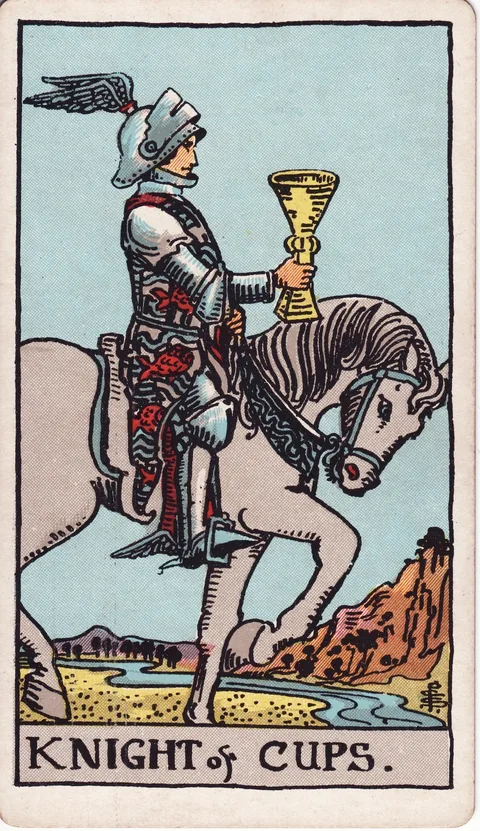 Inspect artwork
Upright meaning #
Upright, communicate what matters with care and take a step toward a meaningful possibility. The Knight brings feeling into motion. A proposal becomes stronger when its practical terms are as clear as its emotional appeal.
Reversed interpretation #
Reversed, consider idealization, an offer that is difficult to sustain or retreat when reality becomes less graceful than the imagined scene. Do not label someone deceptive without evidence. Compare the words, commitments and follow-through.
RWS imagery and symbolism #
A rider on a calm horse carries a cup forward, with a river in the landscape. Winged details reinforce the image of an imaginative messenger. The measured movement differs from the urgency of the Knight of Swords or Wands.
A contextual reading example #
In a reading about proposing a collaboration, the Knight as advice could mean explaining the creative vision and making a concrete invitation. Include the time and work involved. The card would not guarantee that enthusiasm is mutual.
Distinctions and limits #
The Knight does not identify a destined romantic partner or a person of a particular gender. Golden Dawn court naming differs from RWS, so assigning an astrological sign merely because both systems use the word Knight would be misleading.
Sources & editorial notes
Original explanations and hypothetical examples prepared with AI assistance for Synergy. Sources document the traditions described; they do not establish predictive or causal validity.
Rider–Waite–Smith artwork by Pamela Colman Smith, public domain. Images are resized historical scans from Wikimedia Commons; the full card images retain their borders and original coloring. Image sources and credits.
- A. E. Waite, The Pictorial Key to the Tarot (1911), illustrated by Pamela Colman Smith
Part III, Knight of Cups: imagery and historical divinatory meanings. Contextual examples and reversal options are original modern reflective interpretations; historical gender stereotypes and predictive claims are not adopted.
Related tarot reading

Put it into practice
The daily reading uses 22 Major Arcana cards. A draw is not guaranteed to include the card you are studying.
Try Synergy’s daily one-card reading (Major Arcana only) →