On this page
AT A GLANCE
A reversed card appears upside down relative to the reader. Some tarot readers interpret reversals; others use upright cards only. A reversal is not automatically the opposite meaning or a bad outcome. Choose the method before drawing and apply it consistently.
Explore tarot foundations →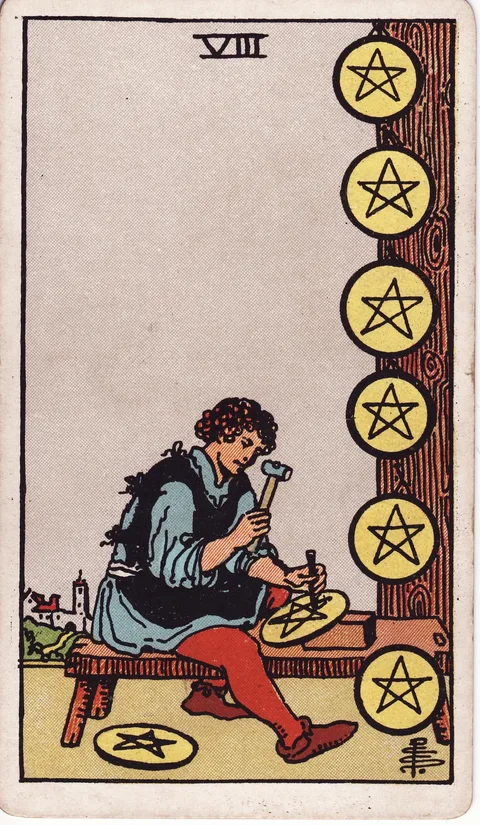
Three useful ways to read a reversal #
One approach is blocked or delayed expression: the card’s theme is present but has difficulty becoming effective. Another is internal expression: the issue is being considered privately. A third is excess or imbalance: the theme is pushed beyond a useful proportion.
These are alternatives to evaluate, not a checklist that makes every possible event fit. Our card entries offer context-specific possibilities. They do not claim that every historical author used the same reversal rules.
Worked example: Eight of Pentacles #
Upright Eight of Pentacles can suggest attentive practice. Reversed in an action position, it might ask whether repeated effort lacks feedback or whether the practice method needs changing. The response is to inspect the learning process.
It need not mean ‘stop working’ or ‘you have no skill.’ The visible scene still matters. If the actual problem is overwork, a rest or reduction in scope may be more relevant than yet another practice session.
Decide the mechanics in advance #
If using reversals, allow card orientation to vary when shuffling or use a selection method that explicitly supports it. If reading upright only, orient the cards upright and interpret challenge through the position and surrounding cards.
For a sideways crossing card in a Celtic Cross, state a rule before drawing. This library’s spread suggests using the core meaning of that second card without a reversal, so sideways placement itself does not become an ambiguous signal.
No need to double a memorized dictionary #
Waite includes historical reversed meanings for many cards, sometimes quite unlike modern blocked-energy explanations. You can study those differences without treating one list as universally correct. Deck guides and named methods may disagree.
A reversal does not prove a curse, a doomed relationship or a hidden negative fact. Upright cards can raise difficult questions, and reversed cards can support constructive change. Read the actual situation rather than assigning moral value to orientation.
Sources & editorial notes
Original explanations and hypothetical examples prepared with AI assistance for Synergy. Sources document the traditions described; they do not establish predictive or causal validity.
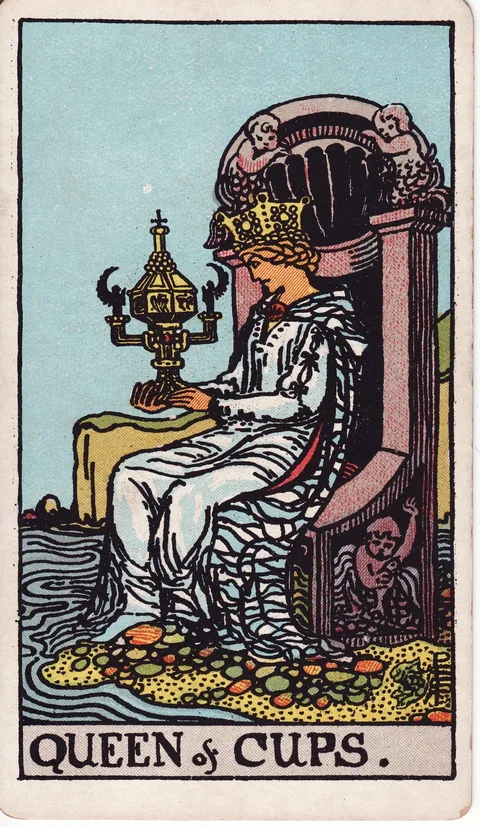
Rider–Waite–Smith artwork by Pamela Colman Smith, public domain. Images are resized historical scans from Wikimedia Commons; the full card images retain their borders and original coloring. Image sources and credits.
- A. E. Waite, The Pictorial Key to the Tarot (1911), illustrated by Pamela Colman Smith
Parts II–III: historical imagery, divinatory meanings and use of positions. Modern reflective procedures and examples are editorial choices.
- Golden Dawn, Book T: The Tarot (historical manuscript compilation)
Historical suit and court structure; specialized correspondence methods are distinct from the beginner method used here.
Related tarot reading
How to read tarot
A practical sequence for questions, positions, images, interpretation and a useful next step.
Interpreting tarot cards together
Combine positions, repeated motifs and contrasts without turning a spread into an arbitrary story.
Rider–Waite–Smith, Marseille and Thoth
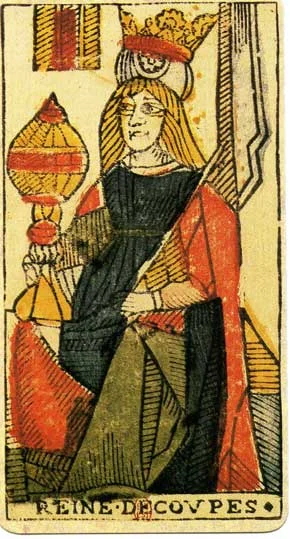
Compare imagery, numbering and court titles across three influential tarot traditions.
Put it into practice
The daily reading uses 22 Major Arcana cards. A draw is not guaranteed to include the card you are studying.
Try Synergy’s daily one-card reading (Major Arcana only) →