On this page
AT A GLANCE
The Five of Wands concerns friction among active participants: competition, conflicting approaches or effort that lacks coordination. It can be productive disagreement or exhausting noise. The task is to understand what people are competing over and whether the process allows useful progress.
Explore all 78 tarot cards →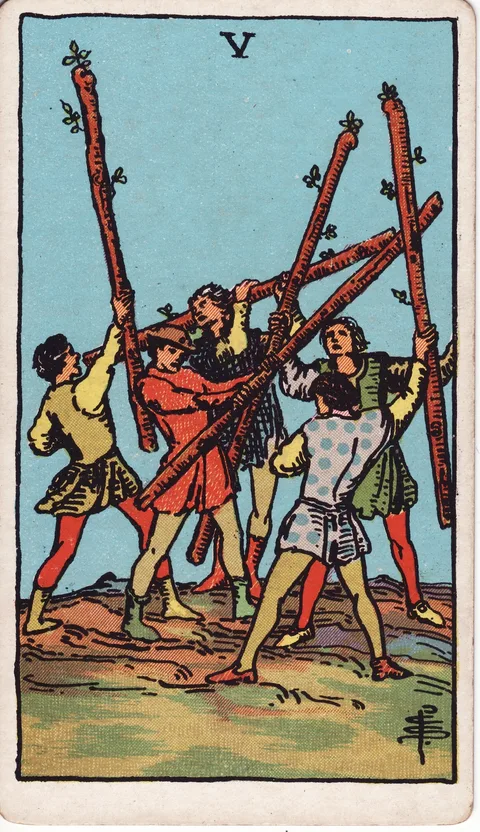 Inspect artwork
Upright meaning #
Upright, expect different ideas or priorities to meet. Rather than suppress every disagreement, clarify the shared task and the rules for participation. Competition can reveal skill or sharpen an idea when its costs and boundaries are understood.
Reversed interpretation #
Reversed, consider conflict going underground, a quarrel losing momentum or a deliberate move toward cooperation. Avoiding visible disagreement does not necessarily resolve the issue. Ask whether people can state the actual problem without turning it into a contest of status.
RWS imagery and symbolism #
Five figures raise wands at different angles. Waite describes the scene in terms of sport or strife, leaving room for practice as well as conflict. The picture does not show the kind of decisive aftermath found in the Five of Swords.
A contextual reading example #
In a brainstorming session where everyone interrupts, the card in an advice position could suggest giving each proposal a short hearing and agreeing on selection criteria. The solution addresses the process rather than labeling any participant an enemy.
Distinctions and limits #
The card is not proof that others are plotting against you. Its Golden Dawn attribution is Saturn in Leo. Interpret the observed disagreement at its actual scale; a minor coordination problem does not need a dramatic conflict narrative.
ACROSS TRADITIONS
Explore the connections
Optional correspondences within named systems. Each connection has its own context and source.
- numerology · Optional numerical readingNumber 5 →
The printed rank is 5. Numerological approaches to tarot can add this general number vocabulary to the image. An original reflection prompt here is friction that calls for adaptation. This is not a Life Path calculation.
Modern numerological tarot; RWS numbering · Source
Sources & editorial notes
Original explanations and hypothetical examples prepared with AI assistance for Synergy. Sources document the traditions described; they do not establish predictive or causal validity.
Rider–Waite–Smith artwork by Pamela Colman Smith, public domain. Images are resized historical scans from Wikimedia Commons; the full card images retain their borders and original coloring. Image sources and credits.
- A. E. Waite, The Pictorial Key to the Tarot (1911), illustrated by Pamela Colman Smith
Part III, Five of Wands: imagery and historical divinatory meanings. Contextual examples and reversal options are original modern reflective interpretations; historical gender stereotypes and predictive claims are not adopted.
Related tarot reading

Put it into practice
The daily reading uses 22 Major Arcana cards. A draw is not guaranteed to include the card you are studying.
Try Synergy’s daily one-card reading (Major Arcana only) →