On this page
AT A GLANCE
The Ace of Swords concerns a clear distinction, insight or decision that cuts through confusion. It invites precise thinking and communication. Clarity is useful when it remains accountable to evidence; feeling certain does not make a conclusion true.
Explore all 78 tarot cards →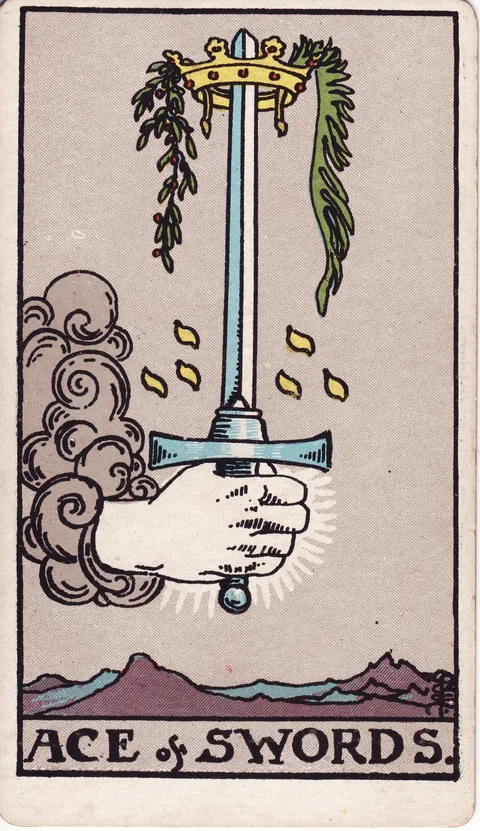 Inspect artwork
Upright meaning #
Upright, define the actual question and name what can be established. A new idea may organize previously scattered information. The Ace’s cutting quality can help end ambiguity, but it should serve understanding rather than the pleasure of winning an argument.
Reversed interpretation #
Reversed, consider incomplete information, a conclusion formed too quickly or difficulty expressing an idea clearly. The useful response may be revising the question and checking terms. Avoid presenting uncertainty as a personal failure.
RWS imagery and symbolism #
A hand emerges from a cloud holding an upright sword crowned with branches. The isolated blade emphasizes distinction and focus, while the crown suggests the authority an idea can claim. That authority needs examination rather than automatic trust.
A contextual reading example #
In a reading about a confusing agreement, the Ace as advice could mean writing down the terms in plain language and asking both parties to confirm them. It would not determine who is legally right or justify a harsh message merely because it sounds decisive.
Distinctions and limits #
The Ace is rank 1 in numerical reading and Air in the Golden Dawn elemental scheme. It is not proof that an intuition is factual. Compare the King of Swords for sustained judgment and responsibility beyond an initial insight.
ACROSS TRADITIONS
Explore the connections
Optional correspondences within named systems. Each connection has its own context and source.
Sources & editorial notes
Original explanations and hypothetical examples prepared with AI assistance for Synergy. Sources document the traditions described; they do not establish predictive or causal validity.
Rider–Waite–Smith artwork by Pamela Colman Smith, public domain. Images are resized historical scans from Wikimedia Commons; the full card images retain their borders and original coloring. Image sources and credits.
- A. E. Waite, The Pictorial Key to the Tarot (1911), illustrated by Pamela Colman Smith
Part III, Ace of Swords: imagery and historical divinatory meanings. Contextual examples and reversal options are original modern reflective interpretations; historical gender stereotypes and predictive claims are not adopted.
Related tarot reading


Put it into practice
The daily reading uses 22 Major Arcana cards. A draw is not guaranteed to include the card you are studying.
Try Synergy’s daily one-card reading (Major Arcana only) →