On this page
AT A GLANCE
The Three of Wands concerns an effort that has begun to reach beyond its starting point. It can suggest expansion, watching results and preparing for what comes back. Unlike the Two’s planning stance, the Three asks how an outward commitment is developing.
Explore all 78 tarot cards →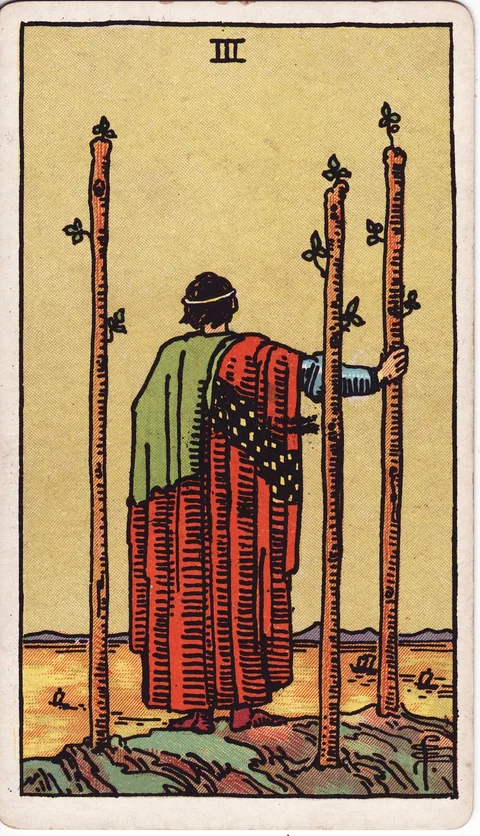 Inspect artwork
Upright meaning #
Upright, assess the response to work already sent out and prepare for the next stage. Opportunities may require coordination rather than another new idea. Look at the horizon without neglecting the practical support that makes further movement possible.
Reversed interpretation #
Reversed, consider delayed feedback, unrealistic expectations about reach or a need to strengthen the base before expanding. A limited response is not necessarily failure. It may reveal a mismatch between the intended audience and the way the work was offered.
RWS imagery and symbolism #
A figure stands on high ground among three planted wands, watching ships on the water. The scene combines a stable vantage point with movement beyond immediate reach. The ships invite attention to exchange and return, not a literal prediction of overseas travel.
A contextual reading example #
After publishing a small guide, a reader draws the Three in an action position. It could suggest reviewing questions from readers and arranging distribution through a relevant group. The next move follows actual response rather than simply producing more material.
Distinctions and limits #
The card does not promise commercial success or travel. Its Golden Dawn association is Sun in Aries. A numerical reading of three as development is optional and should not obscure the particular scene of outward engagement.
ACROSS TRADITIONS
Explore the connections
Optional correspondences within named systems. Each connection has its own context and source.
Sources & editorial notes
Original explanations and hypothetical examples prepared with AI assistance for Synergy. Sources document the traditions described; they do not establish predictive or causal validity.
Rider–Waite–Smith artwork by Pamela Colman Smith, public domain. Images are resized historical scans from Wikimedia Commons; the full card images retain their borders and original coloring. Image sources and credits.
- A. E. Waite, The Pictorial Key to the Tarot (1911), illustrated by Pamela Colman Smith
Part III, Three of Wands: imagery and historical divinatory meanings. Contextual examples and reversal options are original modern reflective interpretations; historical gender stereotypes and predictive claims are not adopted.
Related tarot reading

Put it into practice
The daily reading uses 22 Major Arcana cards. A draw is not guaranteed to include the card you are studying.
Try Synergy’s daily one-card reading (Major Arcana only) →