On this page
AT A GLANCE
The King of Swords concerns responsibility for a decision, standard or body of knowledge. It can suggest disciplined reasoning and clear communication. The authority of the role should come from sound process and relevant evidence, not merely a formal title.
Explore all 78 tarot cards →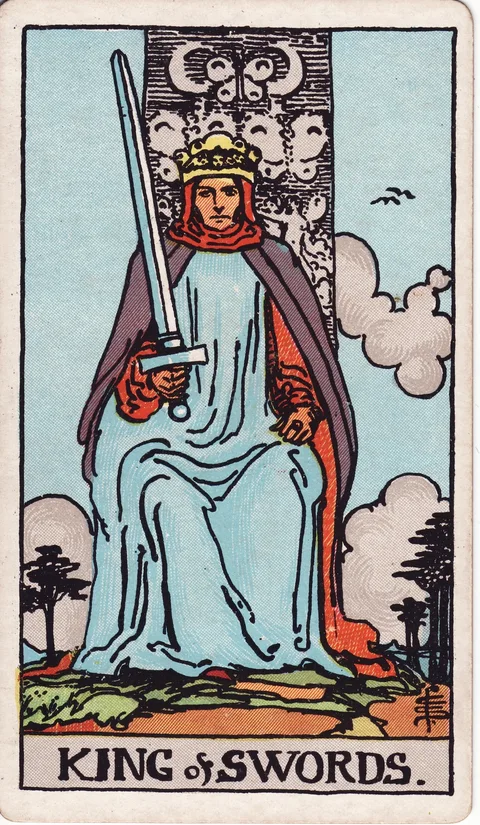 Inspect artwork
Upright meaning #
Upright, establish the criteria, examine the information and explain the reasoning behind a conclusion. A useful decision leaves a record that others can understand and challenge. Expertise is most helpful when its limits are stated.
Reversed interpretation #
Reversed, consider rigid rules, selective use of evidence or authority used to silence a question. It can also indicate difficulty making a necessary decision. Identify the actual process failure instead of assuming that an apparently confident person must know best.
RWS imagery and symbolism #
A seated king holds a sword upright in a frontal, composed pose. The stable position contrasts with the Knight’s charge and the Page’s exploratory alertness. The image suggests stewardship of judgment rather than a single moment of insight.
A contextual reading example #
A group must select among proposals. The King in an advice position could mean agreeing on criteria, comparing evidence and recording why the choice was made. It would not mean one person should decide without consultation simply because they sound logical.
Distinctions and limits #
The card is not proof of legal authority or a substitute for qualified professional advice. It can describe a role of any gender. Clear reasoning remains open to correction when better information becomes available.
Sources & editorial notes
Original explanations and hypothetical examples prepared with AI assistance for Synergy. Sources document the traditions described; they do not establish predictive or causal validity.
Rider–Waite–Smith artwork by Pamela Colman Smith, public domain. Images are resized historical scans from Wikimedia Commons; the full card images retain their borders and original coloring. Image sources and credits.
- A. E. Waite, The Pictorial Key to the Tarot (1911), illustrated by Pamela Colman Smith
Part III, King of Swords: imagery and historical divinatory meanings. Contextual examples and reversal options are original modern reflective interpretations; historical gender stereotypes and predictive claims are not adopted.
Related tarot reading

Put it into practice
The daily reading uses 22 Major Arcana cards. A draw is not guaranteed to include the card you are studying.
Try Synergy’s daily one-card reading (Major Arcana only) →