On this page
AT A GLANCE
A one-card spread uses one card in a position chosen before the draw, such as ‘What deserves my attention?’ It is useful for a focused reflection or study exercise. Its strength is clarity, not a claim that one image can settle every part of a complex decision.
Explore tarot spreads →
- 1. What deserves my attention?
Choose the question and position #
Write a question you can act on, such as ‘What approach could help me prepare for tomorrow’s conversation?’ Name the position ‘Helpful approach.’ Shuffle in any comfortable way and draw one card. If you use reversals, decide that before drawing rather than after seeing the result.
A physical deck, a digital deck or a chosen study card can all support reflection, provided you are clear about how the card was selected. No special ritual is required to read the image, though a quiet routine may help attention.
Read image, position and context together #
Describe what is visibly happening, then connect one or two details to the position. The Page of Swords in ‘Helpful approach’ could suggest preparing questions and checking terms. It does not say that someone is watching you.
Write one tentative sentence and one practical step. If several interpretations are plausible, choose the one best grounded in the question and known circumstances, while acknowledging the uncertainty.
Worked example #
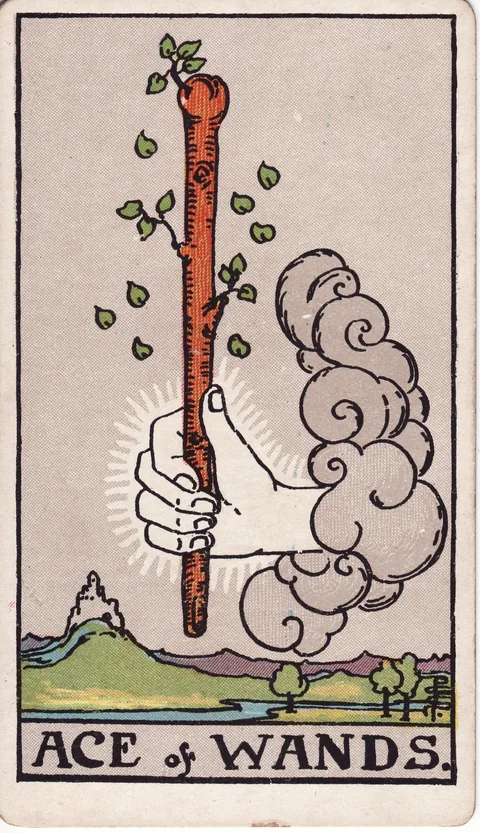
Question: ‘How can I return to drawing after a long break?’ Position: helpful approach. Card: Ace of Wands. The hand and sprouting wand suggest beginning with available enthusiasm. A practical reading is to make one rough sketch using tools already at hand.
The limit is equally useful: the Ace does not promise that the sketch will be good or that the hobby should become a career. Review whether the small action helped, rather than whether the card predicted the day.
Avoid drawing until you get permission #
Repeatedly replacing an unwelcome card can turn a reflection into a search for reassurance. If the first card feels unclear, describe the image more carefully or revise the question for a later reading. An optional clarifier needs a distinct position, such as ‘What is unclear about this approach?’
Synergy’s existing one-card experience uses 22 Major Arcana, while this learning method can use all 78 cards. Neither selection guarantees the card currently being studied.
Sources & editorial notes
Original explanations and hypothetical examples prepared with AI assistance for Synergy. Sources document the traditions described; they do not establish predictive or causal validity.
Rider–Waite–Smith artwork by Pamela Colman Smith, public domain. Images are resized historical scans from Wikimedia Commons; the full card images retain their borders and original coloring. Image sources and credits.
- A. E. Waite, The Pictorial Key to the Tarot (1911), illustrated by Pamela Colman Smith
Part III, sections 6–8: historical evidence for interpreting cards within positions. The layout definitions and worked examples in this guide are editorial teaching choices, not quotations or claims of ancient provenance.
Related tarot reading
How to read tarot
A practical sequence for questions, positions, images, interpretation and a useful next step.
Asking useful tarot questions
Frame questions around context and agency rather than secret knowledge or guaranteed outcomes.
Situation, action and outcome spread
A three-card arrangement that separates the current pattern from a possible response and its direction.

Put it into practice
The daily reading uses 22 Major Arcana cards. A draw is not guaranteed to include the card you are studying.
Try Synergy’s daily one-card reading (Major Arcana only) →