On this page
AT A GLANCE
The Three of Cups concerns enjoyment and support shared among people. It can suggest friendship, celebration or the pleasure of making something together. The card asks how belonging is expressed in practice, rather than promising an invitation or a social success.
Explore all 78 tarot cards →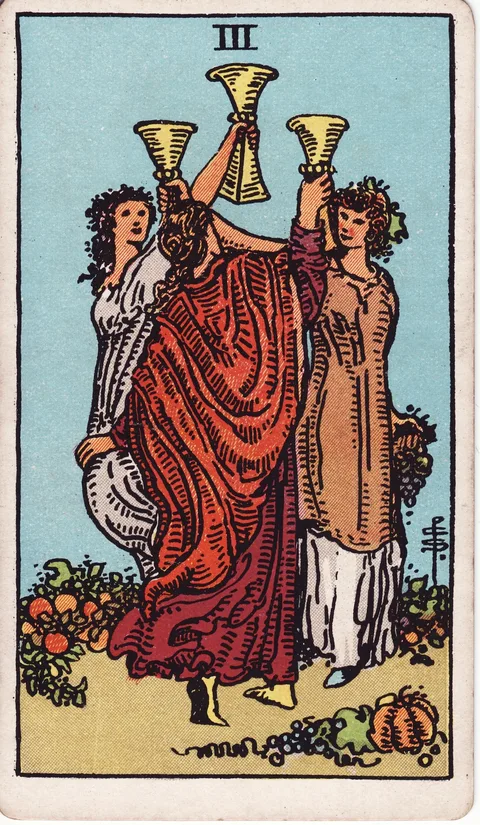 Inspect artwork
Upright meaning #
Upright, make room for mutual celebration and acknowledge the people who help sustain an effort. Informal connection may be as valuable as formal achievement. The card can also prompt collaboration where different contributions create something none could make alone.
Reversed interpretation #
Reversed, consider exclusion, social overload or a gathering whose appearance of enjoyment hides discomfort. It may suggest choosing a smaller circle or being clearer about expectations. Do not infer an affair from the presence of three figures.
RWS imagery and symbolism #
Three people raise cups in a shared circle, surrounded by harvest imagery. Their movement gives the image an active, communal quality. The picture’s abundance comes through participation and a common occasion rather than an isolated possession.
A contextual reading example #
After completing a difficult task, a reader draws the Three as advice. It could suggest thanking the friends who helped and arranging an accessible way to celebrate. The useful question is whether the occasion actually welcomes those people rather than becoming another obligation.
Distinctions and limits #
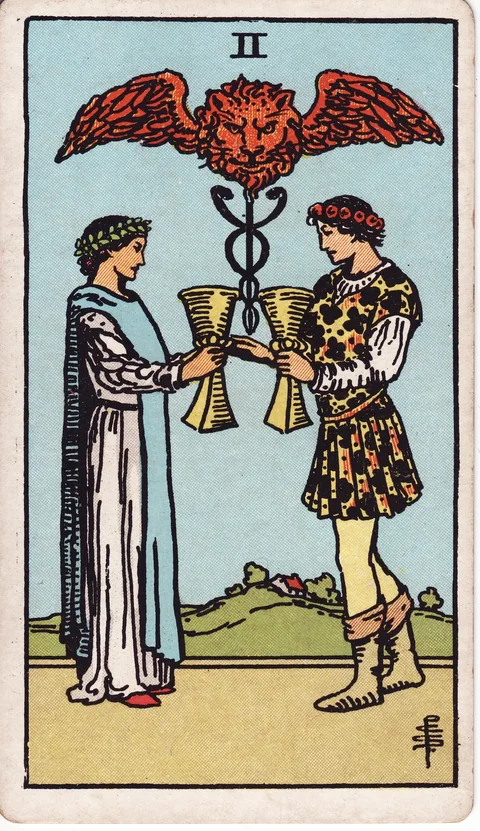
The card is distinct from the Two of Cups’ one-to-one exchange and the Nine’s individual satisfaction. Its Golden Dawn correspondence is Mercury in Cancer. A numerical theme of growth is optional and does not erase the social scene.
ACROSS TRADITIONS
Explore the connections
Optional correspondences within named systems. Each connection has its own context and source.
Sources & editorial notes
Original explanations and hypothetical examples prepared with AI assistance for Synergy. Sources document the traditions described; they do not establish predictive or causal validity.
Rider–Waite–Smith artwork by Pamela Colman Smith, public domain. Images are resized historical scans from Wikimedia Commons; the full card images retain their borders and original coloring. Image sources and credits.
- A. E. Waite, The Pictorial Key to the Tarot (1911), illustrated by Pamela Colman Smith
Part III, Three of Cups: imagery and historical divinatory meanings. Contextual examples and reversal options are original modern reflective interpretations; historical gender stereotypes and predictive claims are not adopted.
Related tarot reading

Put it into practice
The daily reading uses 22 Major Arcana cards. A draw is not guaranteed to include the card you are studying.
Try Synergy’s daily one-card reading (Major Arcana only) →