On this page
AT A GLANCE
The Seven of Wands concerns defending a position under pressure. It asks what is worth protecting and how to respond without exhausting yourself in every available contest. The card can support a clear boundary, but it does not prove that all criticism is hostile.
Explore all 78 tarot cards →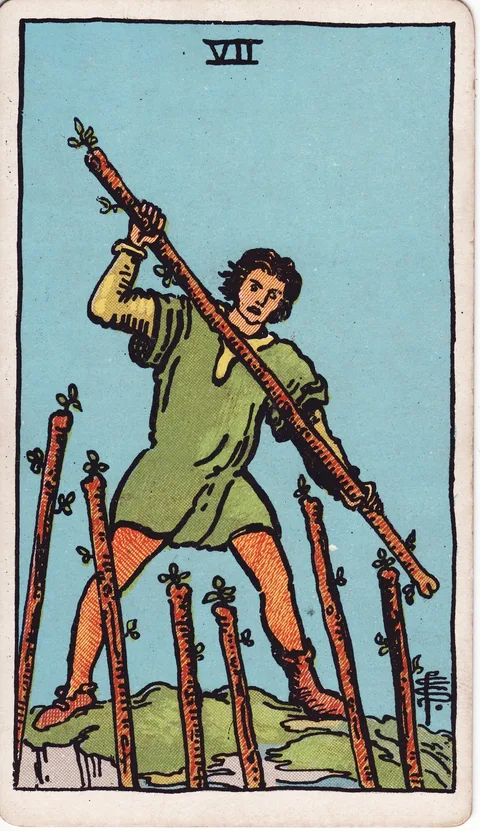 Inspect artwork
Upright meaning #
Upright, identify the principle, work or space that needs defense. You may have an advantage worth using carefully. Distinguish a necessary response from reacting to every challenge; a firm explanation can be more effective than prolonged argument.
Reversed interpretation #
Reversed, consider overwhelm, weakening commitment or a decision to stop defending something that no longer deserves the effort. It may also indicate that support is needed. Stepping away can be strategic rather than cowardly.
RWS imagery and symbolism #
A figure stands on higher ground facing six wands rising from below. The uneven stance and mismatched footwear in the familiar RWS image suggest a response made under pressure. The picture gives a position to defend without telling us that the figure is automatically right.
A contextual reading example #
A community organizer receives conflicting demands after a policy change. The Seven in an advice position could mean restating the agreed purpose, answering substantive concerns and declining abusive exchanges. It would not justify dismissing all feedback.
Distinctions and limits #
Assess actual danger through real information. Golden Dawn assigns Mars in Leo to the card. Its theme of defense is distinct from the Nine of Wands’ accumulated fatigue and vigilance after sustained effort.
ACROSS TRADITIONS
Explore the connections
Optional correspondences within named systems. Each connection has its own context and source.
Sources & editorial notes
Original explanations and hypothetical examples prepared with AI assistance for Synergy. Sources document the traditions described; they do not establish predictive or causal validity.
Rider–Waite–Smith artwork by Pamela Colman Smith, public domain. Images are resized historical scans from Wikimedia Commons; the full card images retain their borders and original coloring. Image sources and credits.
- A. E. Waite, The Pictorial Key to the Tarot (1911), illustrated by Pamela Colman Smith
Part III, Seven of Wands: imagery and historical divinatory meanings. Contextual examples and reversal options are original modern reflective interpretations; historical gender stereotypes and predictive claims are not adopted.
Related tarot reading

Put it into practice
The daily reading uses 22 Major Arcana cards. A draw is not guaranteed to include the card you are studying.
Try Synergy’s daily one-card reading (Major Arcana only) →