On this page
AT A GLANCE
The Moon concerns uncertainty, ambiguous impressions and the powerful stories that arise when not everything is visible. It invites care in distinguishing feeling from fact. The card does not establish deception, psychic knowledge or a hidden threat.
Explore all 78 tarot cards →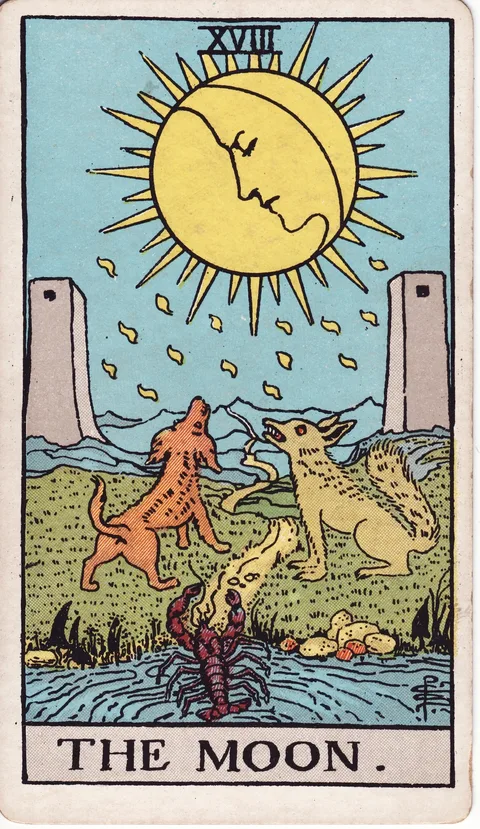 Inspect artwork
Upright meaning #
Upright, allow uncertainty to remain named rather than forcing a confident explanation. Dreams and associations may reveal concerns worth exploring, but they do not verify an external event. A useful question is what information would make the next step clearer.
Reversed interpretation #
Reversed, consider confusion beginning to lift, an avoided fear becoming discussable or an assumption still resisting scrutiny. Different questions support different readings. Seek clarity through observation and conversation rather than declaring that a reversal exposes the truth.
RWS imagery and symbolism #
Smith shows a path between towers beneath the Moon, with a dog, a wolf and a creature emerging from water. Familiar and unfamiliar animals occupy the same scene. The path continues beyond what can be seen, making uncertainty part of the image rather than a problem instantly solved.
A contextual reading example #
A delayed reply leads someone to imagine several negative explanations. The Moon in a situation position could name that uncertainty. An appropriate action might be a clear follow-up or waiting for agreed timing, rather than using the card to confirm the most frightening story.
Distinctions and limits #
The tarot Moon is XVIII. Golden Dawn assigns it to Pisces; the astrological Moon corresponds to the High Priestess. This is a useful example of why similar names alone cannot generate cross-domain links.
ACROSS TRADITIONS
Explore the connections
Optional correspondences within named systems. Each connection has its own context and source.
Sources & editorial notes
Original explanations and hypothetical examples prepared with AI assistance for Synergy. Sources document the traditions described; they do not establish predictive or causal validity.
Rider–Waite–Smith artwork by Pamela Colman Smith, public domain. Images are resized historical scans from Wikimedia Commons; the full card images retain their borders and original coloring. Image sources and credits.
- A. E. Waite, The Pictorial Key to the Tarot (1911), illustrated by Pamela Colman Smith
Part II, this card’s imagery; compare Part III for historical divinatory meanings. Upright and reversed examples here are original reflective interpretations, not a transcription of Waite’s fortune-telling rules.
Related tarot reading

Put it into practice
The daily reading uses 22 Major Arcana cards. A draw is not guaranteed to include the card you are studying.
Try Synergy’s daily one-card reading (Major Arcana only) →