On this page
AT A GLANCE
The High Priestess invites attentive stillness when a situation is not fully understood. It can symbolize intuition, private knowledge and the value of not forcing an answer. An impression may be worth exploring, but the card does not establish secret facts or another person’s thoughts.
Explore all 78 tarot cards →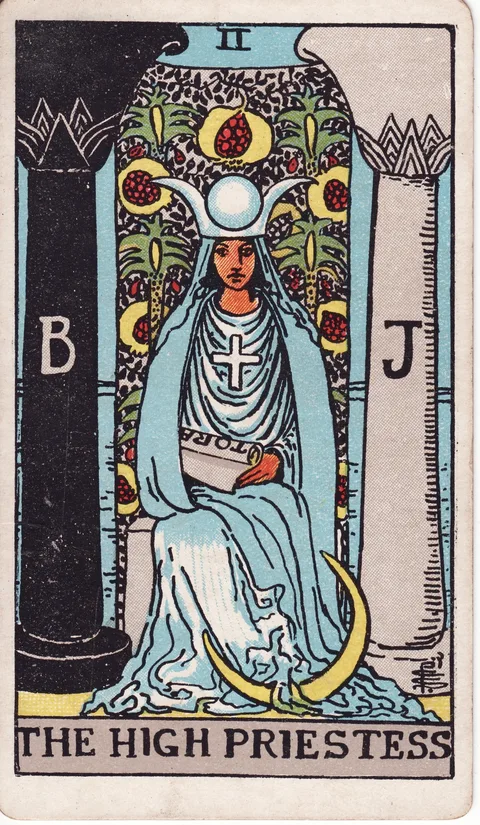 Inspect artwork
Upright meaning #
Upright, pause long enough to notice what you know, what you suspect and what remains unknown. Listening can be an active response. Unlike the Magician’s outward use of tools, the High Priestess emphasizes receiving and holding complexity before acting.
Reversed interpretation #
Reversed, consider whether you are dismissing an important impression, avoiding available facts or becoming preoccupied with secrets. A useful response is to distinguish observation from interpretation. Silence may protect privacy, but it can also prevent a necessary conversation; context decides.
RWS imagery and symbolism #
Smith places a seated figure between dark and light pillars, before a patterned veil. A crescent Moon rests near her feet, and a scroll is partly covered. These details create a threshold between visible and concealed knowledge rather than an invitation to invent what lies behind it.
A contextual reading example #
Asked how to approach an unclear workplace change, the card in an advice position could suggest listening carefully and writing down specific questions before making assumptions. It should not become a claim that management is hiding a particular event. Seek direct information where it is available.
Distinctions and limits #
The High Priestess is not restricted to women, and intuition is not infallibility. Its Golden Dawn correspondence is the astrological Moon; the tarot Moon card has a different assignment, Pisces. Similar names do not make those two relationships identical.
ACROSS TRADITIONS
Explore the connections
Optional correspondences within named systems. Each connection has its own context and source.
Sources & editorial notes
Original explanations and hypothetical examples prepared with AI assistance for Synergy. Sources document the traditions described; they do not establish predictive or causal validity.
Rider–Waite–Smith artwork by Pamela Colman Smith, public domain. Images are resized historical scans from Wikimedia Commons; the full card images retain their borders and original coloring. Image sources and credits.
- A. E. Waite, The Pictorial Key to the Tarot (1911), illustrated by Pamela Colman Smith
Part II, this card’s imagery; compare Part III for historical divinatory meanings. The reflective upright, reversal and reading examples here are original modern interpretations, not quotations from Waite.
Related tarot reading

Put it into practice
The daily reading uses 22 Major Arcana cards. A draw is not guaranteed to include the card you are studying.
Try Synergy’s daily one-card reading (Major Arcana only) →