On this page
AT A GLANCE
The Two of Pentacles concerns balancing practical demands in motion: time, money, work or attention. It asks how to adjust as conditions change. Balance is not a permanent state in this card, and juggling more tasks is not automatically a sign of competence.
Explore all 78 tarot cards →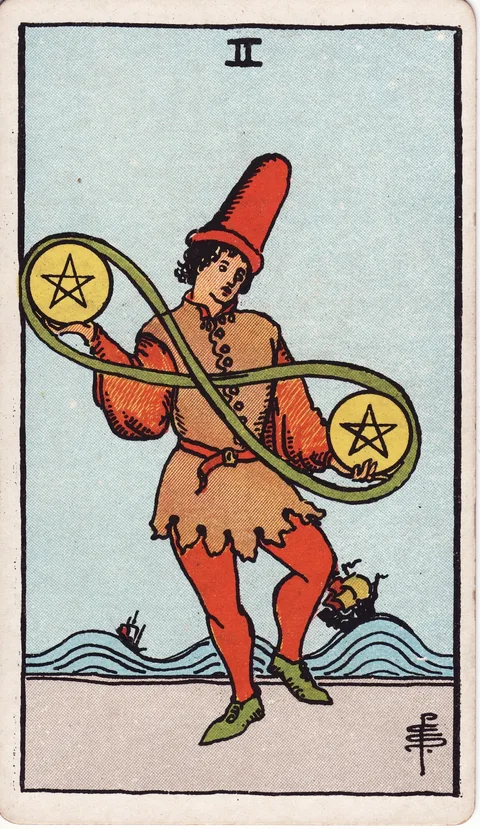 Inspect artwork
Upright meaning #
Upright, identify the priorities that must remain steady while other arrangements flex. A simple rhythm or visible schedule can help. The card often speaks to managing ordinary fluctuations rather than making a single dramatic choice.
Reversed interpretation #
Reversed, consider overload, missed details or a system that depends on constant improvisation. The response may be reducing commitments rather than becoming a better juggler. Name what cannot be carried simultaneously.
RWS imagery and symbolism #
A figure handles two pentacles linked by an infinity-shaped band, while ships ride waves behind. The foreground rhythm and background motion make adaptation central. The scene shows activity within changing conditions rather than complete control over them.
A contextual reading example #
A reader combining study and paid work draws the Two as advice. It could suggest mapping the week, protecting essential tasks and deciding what to pause during busy periods. The card would not promise that every demand can be met with enough positivity.
Distinctions and limits #
Do not use the image to dismiss genuine resource constraints. Golden Dawn assigns Jupiter in Capricorn. The rank’s duality is an optional numerical layer, not a calculation of the reader’s Personal Year or Life Path.
ACROSS TRADITIONS
Explore the connections
Optional correspondences within named systems. Each connection has its own context and source.
- astrology · Planetary decanCapricorn →
Book T assigns this card to Jupiter in Capricorn, the first ten-degree division of Capricorn. This decan correspondence is specific to Golden Dawn tarot; it does not predict an event for people born under the sign.
Golden Dawn / Book T · Source
Sources & editorial notes
Original explanations and hypothetical examples prepared with AI assistance for Synergy. Sources document the traditions described; they do not establish predictive or causal validity.
Rider–Waite–Smith artwork by Pamela Colman Smith, public domain. Images are resized historical scans from Wikimedia Commons; the full card images retain their borders and original coloring. Image sources and credits.
- A. E. Waite, The Pictorial Key to the Tarot (1911), illustrated by Pamela Colman Smith
Part III, Two of Pentacles: imagery and historical divinatory meanings. Contextual examples and reversal options are original modern reflective interpretations; historical gender stereotypes and predictive claims are not adopted.
Related tarot reading
Pentacles
The suit of resources, craft, practical care and the conditions that sustain everyday life.
Interpreting tarot cards together
Combine positions, repeated motifs and contrasts without turning a spread into an arbitrary story.
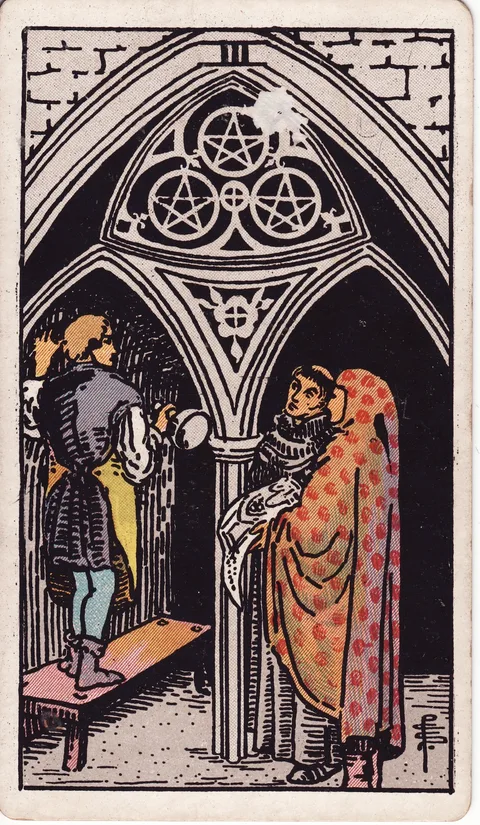
Three of Pentacles
Skilled contribution and work improved through collaboration

Put it into practice
The daily reading uses 22 Major Arcana cards. A draw is not guaranteed to include the card you are studying.
Try Synergy’s daily one-card reading (Major Arcana only) →