On this page
AT A GLANCE
The Ace of Cups concerns emotional receptivity, affection or creative feeling beginning to flow. It may invite openness to an experience without deciding in advance what it must become. It is not a guarantee of romance, pregnancy or an overwhelming spiritual event.
Explore all 78 tarot cards →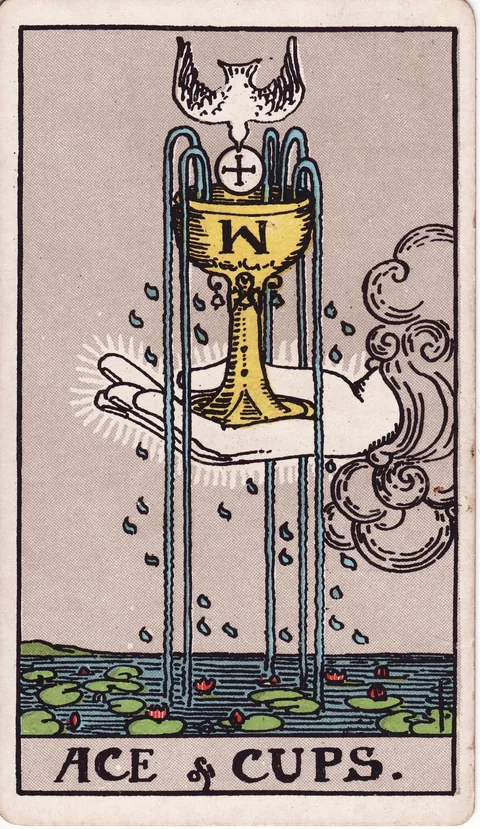 Inspect artwork
Upright meaning #
Upright, notice a feeling that deserves attention and create room to receive or express it. The beginning may be quiet: accepting kindness, returning to art or recognizing a wish for connection. The Ace offers a capacity, while an actual relationship requires mutual participation.
Reversed interpretation #
Reversed, consider feeling held back, emotional depletion or an experience that needs private space before being shared. It may be wise to replenish rather than give more. The card does not establish that another person secretly loves you.
RWS imagery and symbolism #
A hand presents an overflowing cup above water and water lilies, with a descending dove. The image joins receiving with abundance that moves outward. Its religious symbolism belongs to the deck’s historical vocabulary and can be studied without adopting a literal spiritual claim.
A contextual reading example #
After a period of isolation, a reader draws the Ace as advice. A useful step might be accepting a trusted friend’s invitation or writing honestly about a feeling. The invitation is to make room for contact, not to assume every new encounter will become intimate.
Distinctions and limits #
The Ace is treated as rank 1 in numerical readings. Its Golden Dawn elemental association is Water. Emotional openness does not require abandoning boundaries or treating an intense first impression as proof of compatibility.
ACROSS TRADITIONS
Explore the connections
Optional correspondences within named systems. Each connection has its own context and source.
Sources & editorial notes
Original explanations and hypothetical examples prepared with AI assistance for Synergy. Sources document the traditions described; they do not establish predictive or causal validity.
Rider–Waite–Smith artwork by Pamela Colman Smith, public domain. Images are resized historical scans from Wikimedia Commons; the full card images retain their borders and original coloring. Image sources and credits.
- A. E. Waite, The Pictorial Key to the Tarot (1911), illustrated by Pamela Colman Smith
Part III, Ace of Cups: imagery and historical divinatory meanings. Contextual examples and reversal options are original modern reflective interpretations; historical gender stereotypes and predictive claims are not adopted.
Related tarot reading

Put it into practice
The daily reading uses 22 Major Arcana cards. A draw is not guaranteed to include the card you are studying.
Try Synergy’s daily one-card reading (Major Arcana only) →