On this page
AT A GLANCE
The Four of Swords concerns stepping out of active conflict or demand for a period of rest and reflection. It asks what can be paused so attention can recover. The card does not diagnose illness or tell someone to stop necessary treatment or responsibilities.
Explore all 78 tarot cards →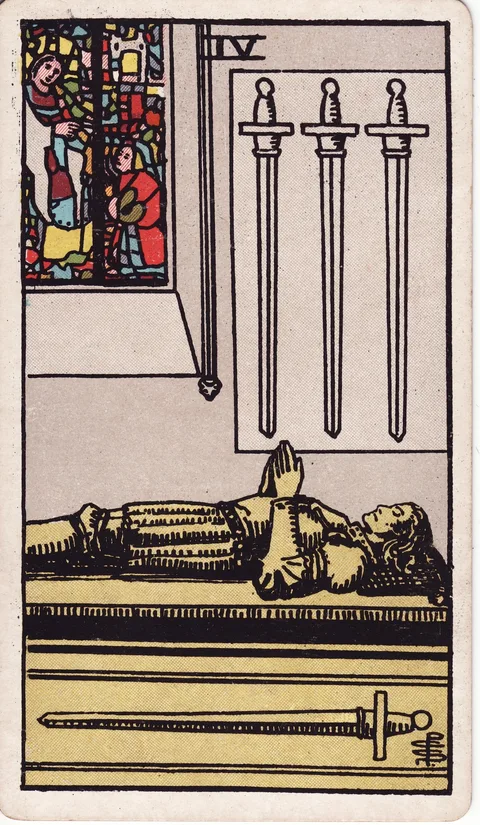 Inspect artwork
Upright meaning #
Upright, create a defined interval with fewer inputs. Rest can be purposeful without becoming another achievement target. A quiet review may help, but the central task may simply be not adding more demands for a while.
Reversed interpretation #
Reversed, consider difficulty resting, returning before capacity is restored or readiness to rejoin activity after a pause. The reading should follow the person’s actual condition. A symbolic card cannot establish whether someone is medically ready to resume work.
RWS imagery and symbolism #
A recumbent figure lies in a church-like space, with three swords above and one beneath. The stillness and separation from an active scene support a reading of withdrawal. The image can be studied without interpreting it as a prediction of death.
A contextual reading example #
After weeks of contentious meetings, the Four in an advice position could suggest a day without debate and a scheduled time to revisit the issue. A clear return point helps distinguish a restorative pause from avoiding a decision indefinitely.
Distinctions and limits #
The Four is distinct from the Two’s guarded stalemate and the Hermit’s sustained inquiry. Golden Dawn assigns Jupiter in Libra. Rest is not laziness, and the need for it does not imply that the reader has failed.
ACROSS TRADITIONS
Explore the connections
Optional correspondences within named systems. Each connection has its own context and source.
- numerology · Optional numerical readingNumber 4 →
The printed rank is 4. Numerological approaches to tarot can add this general number vocabulary to the image. An original reflection prompt here is a bounded interval for recovery. This is not a Life Path calculation.
Modern numerological tarot; RWS numbering · Source
Sources & editorial notes
Original explanations and hypothetical examples prepared with AI assistance for Synergy. Sources document the traditions described; they do not establish predictive or causal validity.
Rider–Waite–Smith artwork by Pamela Colman Smith, public domain. Images are resized historical scans from Wikimedia Commons; the full card images retain their borders and original coloring. Image sources and credits.
- A. E. Waite, The Pictorial Key to the Tarot (1911), illustrated by Pamela Colman Smith
Part III, Four of Swords: imagery and historical divinatory meanings. Contextual examples and reversal options are original modern reflective interpretations; historical gender stereotypes and predictive claims are not adopted.
Related tarot reading


Put it into practice
The daily reading uses 22 Major Arcana cards. A draw is not guaranteed to include the card you are studying.
Try Synergy’s daily one-card reading (Major Arcana only) →