On this page
AT A GLANCE
The Knight of Swords concerns forceful movement toward an idea, argument or objective. It can bring decisiveness and intellectual courage, but its speed can outrun context. The card asks whether urgency serves the task or simply the impulse to act.
Explore all 78 tarot cards →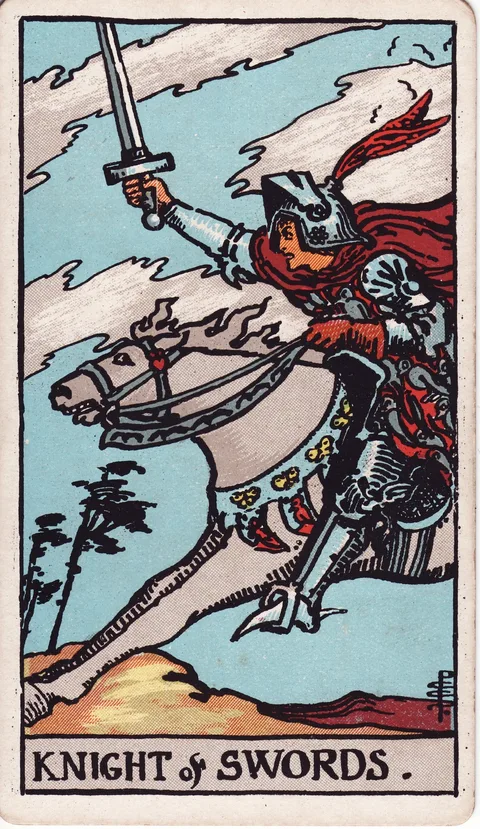 Inspect artwork
Upright meaning #
Upright, state the issue clearly and address what cannot be postponed. The Knight’s directness can cut through avoidance. Before moving, identify who will be affected and whether essential information is missing.
Reversed interpretation #
Reversed, consider haste, argumentative momentum or a blocked action that needs a better route. It can also ask whether fear of confrontation is preventing a necessary statement. Context determines whether to slow down or speak more clearly.
RWS imagery and symbolism #
A mounted figure charges forward with sword raised, while the horse and clouds reinforce the scene’s urgency. The image emphasizes pursuit rather than deliberation. It does not establish that the rider’s cause is correct.
A contextual reading example #
A reader wants to send a sharp reply during a dispute. The Knight in a caution position could suggest drafting it, checking the facts and choosing words that address the issue rather than escalate status conflict. In an action position, it might support a concise, timely response.
Distinctions and limits #
The card does not identify a dangerous person or predict an accident. Courts are roles and approaches, not fixed demographics. Speed and conviction need accountability just as much as a slow, formal decision does.
Sources & editorial notes
Original explanations and hypothetical examples prepared with AI assistance for Synergy. Sources document the traditions described; they do not establish predictive or causal validity.
Rider–Waite–Smith artwork by Pamela Colman Smith, public domain. Images are resized historical scans from Wikimedia Commons; the full card images retain their borders and original coloring. Image sources and credits.
- A. E. Waite, The Pictorial Key to the Tarot (1911), illustrated by Pamela Colman Smith
Part III, Knight of Swords: imagery and historical divinatory meanings. Contextual examples and reversal options are original modern reflective interpretations; historical gender stereotypes and predictive claims are not adopted.
Related tarot reading

Put it into practice
The daily reading uses 22 Major Arcana cards. A draw is not guaranteed to include the card you are studying.
Try Synergy’s daily one-card reading (Major Arcana only) →