On this page
AT A GLANCE
Read tarot by defining a question, assigning positions before drawing, observing the cards and connecting the images to the actual situation. Finish with a tentative interpretation and a practical next step. You do not need to memorize every association before beginning.
Explore tarot foundations →
1. Set a clear scope #
Choose a question you can meaningfully discuss, such as ‘What could help me prepare for this conversation?’ Avoid asking the cards to reveal another person’s private thoughts. Decide whether you will use reversals and which spread positions you will use before drawing.
Shuffle in a way that is comfortable and accessible. There is no requirement to perform a particular ritual. If reading for someone else, agree on the question and allow them to decline a topic or disagree with an interpretation.
2. Describe before interpreting #
Name what is visible: figures, actions, objects, posture and setting. Then consult the card’s suit or Major Arcana context. This prevents a memorized word from overriding a picture that points toward a more specific question.
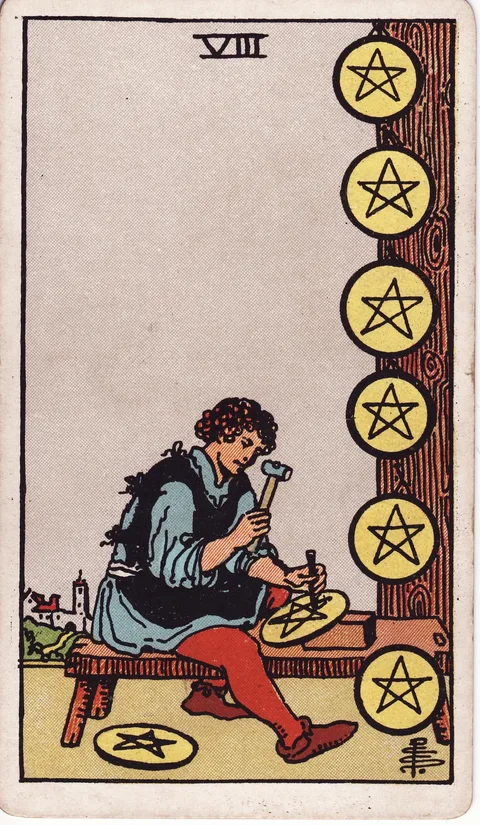
For Eight of Pentacles, a useful observation is a worker repeating a craft, with completed examples nearby. ‘Practice with feedback’ is a grounded interpretation; ‘You will get a promotion’ adds a claim the image cannot establish.
3. Connect the card to its position #
In an action position, Eight of Pentacles might suggest a small, repeatable exercise. As an obstacle, it might ask whether polishing a skill has become a way to avoid sharing the work. Both readings must be checked against the known situation.
With several cards, read each position first and then connect the ideas. Prefer one coherent interpretation over a list of every possible keyword. The combination guide shows how to preserve each card’s role.
4. End with something usable #
Write the question, cards, positions, interpretation and one action or reflection prompt. Later, review what was useful and what was not. This is more informative than remembering only readings that seemed to fit.
If the reading remains unclear, say so. More cards do not necessarily provide more clarity. Use real evidence and relevant expertise for decisions with significant consequences, and keep the cards from becoming a substitute for necessary conversations.
Sources & editorial notes
Original explanations and hypothetical examples prepared with AI assistance for Synergy. Sources document the traditions described; they do not establish predictive or causal validity.
Rider–Waite–Smith artwork by Pamela Colman Smith, public domain. Images are resized historical scans from Wikimedia Commons; the full card images retain their borders and original coloring. Image sources and credits.
The opening scene is an AI-generated editorial illustration. Illustration credits and prompts.
- A. E. Waite, The Pictorial Key to the Tarot (1911), illustrated by Pamela Colman Smith
Parts II–III: historical imagery, divinatory meanings and use of positions. Modern reflective procedures and examples are editorial choices.
- Golden Dawn, Book T: The Tarot (historical manuscript compilation)
Historical suit and court structure; specialized correspondence methods are distinct from the beginner method used here.
Related tarot reading
Asking useful tarot questions
Frame questions around context and agency rather than secret knowledge or guaranteed outcomes.
Upright and reversed cards
Choose a consistent reversal method and keep the card’s image and position central.
Interpreting tarot cards together
Combine positions, repeated motifs and contrasts without turning a spread into an arbitrary story.

Put it into practice
The daily reading uses 22 Major Arcana cards. A draw is not guaranteed to include the card you are studying.
Try Synergy’s daily one-card reading (Major Arcana only) →