On this page
AT A GLANCE
Pentacles are the tarot suit commonly associated with material conditions: resources, skill, work, maintenance and practical care. They ask how an intention becomes sustainable in daily life. Money is one topic, but the suit also concerns time, access, tools and the quality of ordinary support.
Explore the four suits →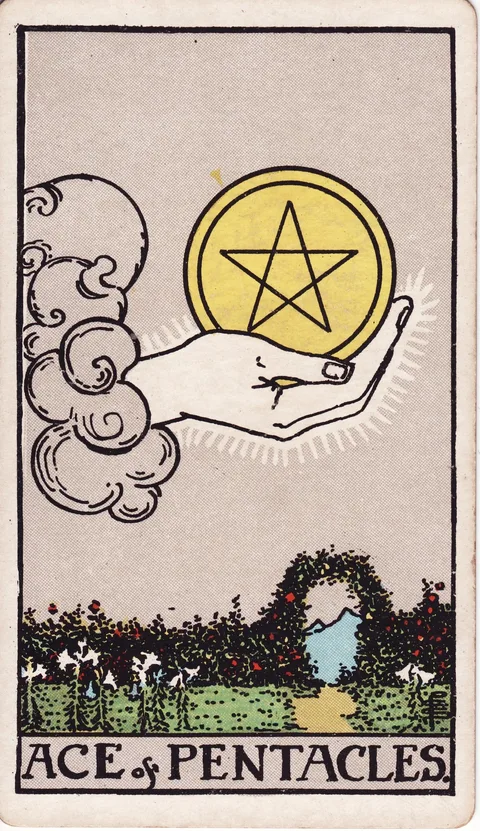
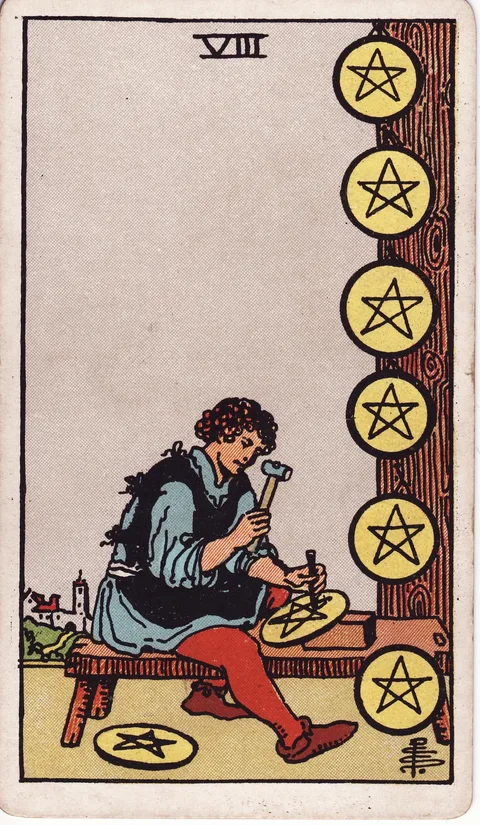
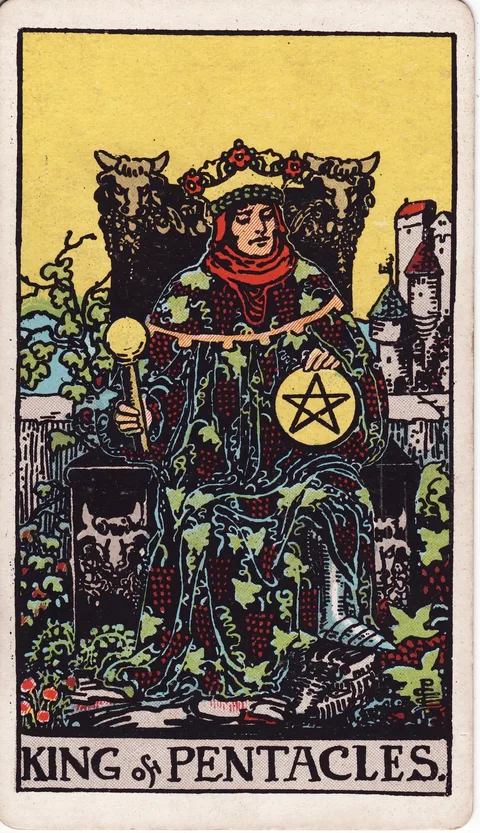
A practical and embodied vocabulary #
Golden Dawn-derived tarot associates Pentacles with Earth. Other decks use Coins, Disks or Discs. A pentacle in RWS is a disk bearing a five-pointed star; the suit name does not make every depicted object a claim about ritual practice.
Read material circumstances accurately. A card can prompt reflection on a resource problem, but it cannot assess an investment, diagnose health or prove that hardship results from someone’s attitude.
From opportunity to continuity #
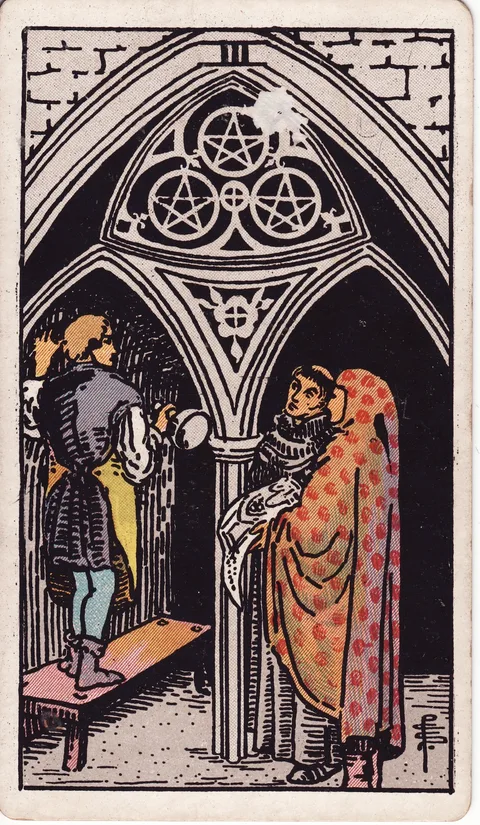
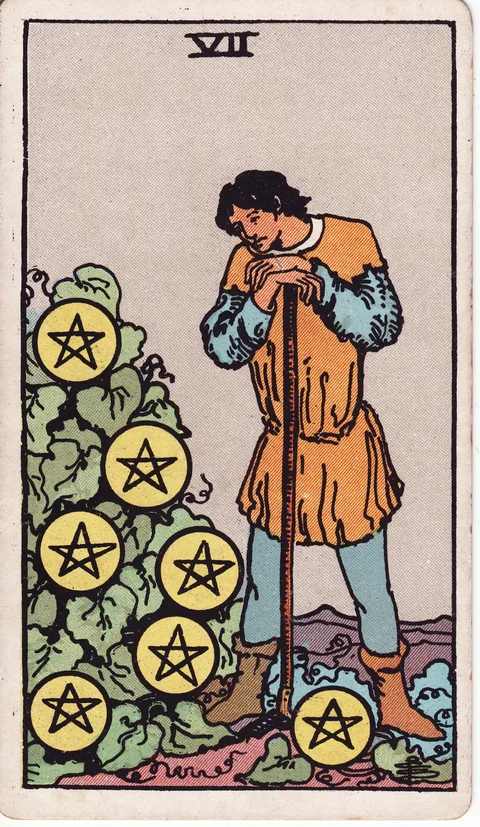
The Ace offers potential; the Two adapts; the Three coordinates skill; the Four protects. The Five confronts hardship or exclusion, the Six distribution, and the Seven assessment. The sequence includes unequal conditions as well as individual effort.
The Eight practices, the Nine enjoys cultivated independence and the Ten considers shared continuity. Three emphasizes collaboration, while Eight focuses on repeated practice. Neither alone describes every kind of work.
Four practical roles #
The Page learns, the Knight carries out a sustainable routine, the Queen creates supportive everyday conditions and the King stewards established resources. These roles can be practiced by anyone. They do not rank people by wealth, age or gender.
A suit-level example #
In a study reading, Seven of Pentacles as situation and Page of Pentacles as action could suggest reviewing progress and returning to a specific basic exercise. The response is a practical learning choice, not a prediction of eventual income.
An emphasis on Pentacles may invite attention to what makes life workable. It should also make social support and access visible, rather than presenting everyone as fully responsible for the resources they have or lack.
ACROSS TRADITIONS
Explore the connections
Optional correspondences within named systems. Each connection has its own context and source.
Sources & editorial notes
Original explanations and hypothetical examples prepared with AI assistance for Synergy. Sources document the traditions described; they do not establish predictive or causal validity.
Rider–Waite–Smith artwork by Pamela Colman Smith, public domain. Images are resized historical scans from Wikimedia Commons; the full card images retain their borders and original coloring. Image sources and credits.
- A. E. Waite, The Pictorial Key to the Tarot (1911), illustrated by Pamela Colman Smith
Parts I–III: deck divisions, suit images and card sequence. Interpretive examples here are original.
- Golden Dawn, Book T: The Tarot (historical manuscript compilation)
Printed pages 3–7 and the suit sections: Golden Dawn elemental and astrological attributions.
Related tarot reading
Put it into practice
The daily reading uses 22 Major Arcana cards. A draw is not guaranteed to include the card you are studying.
Try Synergy’s daily one-card reading (Major Arcana only) →