On this page
AT A GLANCE
The Seven of Cups concerns possibilities that are vivid but not yet clearly evaluated. It can describe imagination, desire or confusion among attractive and troubling options. The task is to distinguish what can be pursued from what only holds attention.
Explore all 78 tarot cards →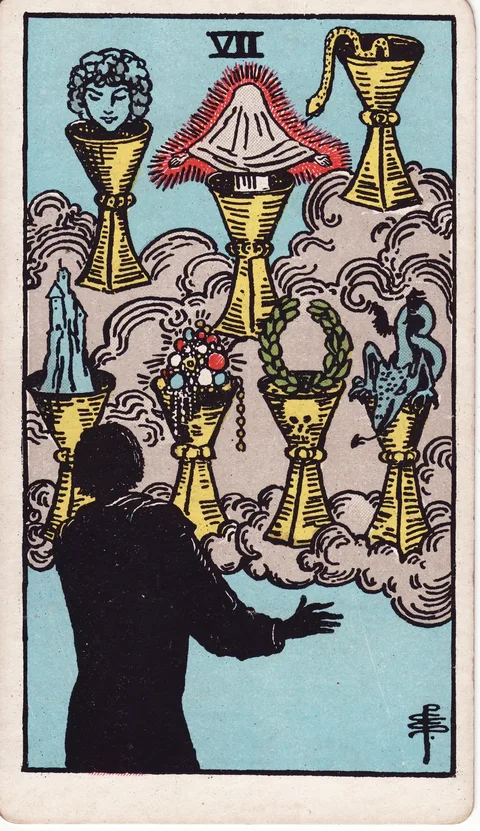 Inspect artwork
Upright meaning #
Upright, list the options and ask what each actually involves. Imagination is useful for generating possibilities; evaluation requires different work. The card may suggest that choosing one path means accepting that not every appealing scenario can be lived at once.
Reversed interpretation #
Reversed, consider gaining clarity, reducing options or prematurely narrowing the field to escape uncertainty. Ask what evidence supports the choice. A strong feeling of certainty is not by itself a reliable filter.
RWS imagery and symbolism #
A silhouetted figure faces cups in clouds containing varied images, including wealth, a wreath, a figure and threatening creatures. Their different contents resist a single label of ‘good options.’ The scene puts desire, fear and fantasy in the same field of view.
A contextual reading example #
In a reading about several project ideas, the Seven as advice could mean comparing time, cost and interest, then trying the most workable one. It would not ask the cards to rank the ideas by destiny. A small prototype can answer questions imagination cannot.
Distinctions and limits #
The card is not a diagnosis of delusion or proof that an offer is fraudulent. Its Golden Dawn correspondence is Venus in Scorpio. Compare the Two of Wands for planning around a more defined choice.
ACROSS TRADITIONS
Explore the connections
Optional correspondences within named systems. Each connection has its own context and source.
Sources & editorial notes
Original explanations and hypothetical examples prepared with AI assistance for Synergy. Sources document the traditions described; they do not establish predictive or causal validity.
Rider–Waite–Smith artwork by Pamela Colman Smith, public domain. Images are resized historical scans from Wikimedia Commons; the full card images retain their borders and original coloring. Image sources and credits.
- A. E. Waite, The Pictorial Key to the Tarot (1911), illustrated by Pamela Colman Smith
Part III, Seven of Cups: imagery and historical divinatory meanings. Contextual examples and reversal options are original modern reflective interpretations; historical gender stereotypes and predictive claims are not adopted.
Related tarot reading

Put it into practice
The daily reading uses 22 Major Arcana cards. A draw is not guaranteed to include the card you are studying.
Try Synergy’s daily one-card reading (Major Arcana only) →