On this page
AT A GLANCE
The Hierophant concerns received knowledge, teachers, institutions and the customs that organize belonging. It asks what a tradition can teach and what participation requires. The card can support learning within a system without demanding unquestioning obedience to it.
Explore all 78 tarot cards →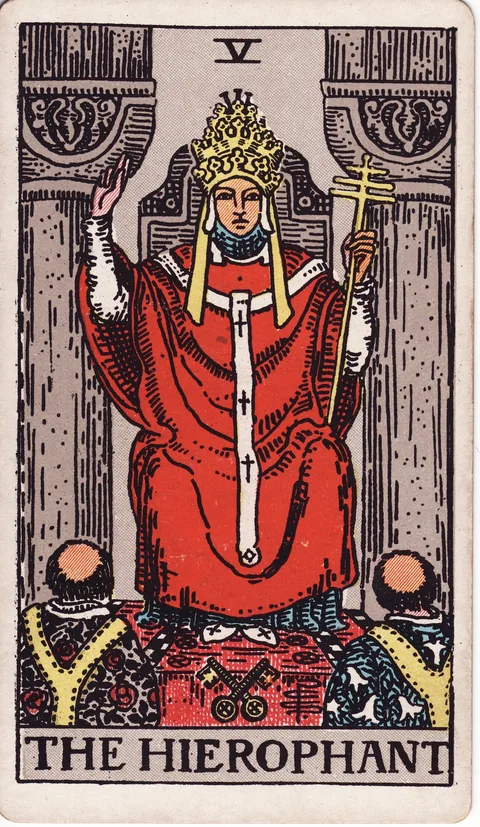 Inspect artwork
Upright meaning #
Upright, seek a useful framework or an experienced teacher. Shared practices can preserve knowledge and help people learn together. The question is whether the framework is appropriate to the task, and whether its standards are clear enough to evaluate.
Reversed interpretation #
Reversed, consider questioning a convention, leaving a constraining role or studying independently. It can also indicate rejecting sound guidance merely because it is structured. Examine the actual rule and its purpose before deciding whether to follow or challenge it.
RWS imagery and symbolism #
Smith depicts a religious authority between pillars, with two attendants and crossed keys below. The scene emphasizes transmission and recognized membership. Its religious imagery reflects the deck’s historical setting; readers need not belong to that religion to explore the broader institutional theme.
A contextual reading example #
In a reading about learning a craft, the Hierophant as the next step might suggest an apprenticeship or a course with clear feedback. As an obstacle, it could highlight a gatekeeping requirement unrelated to competence. The reading should lead to questions about the real institution.
Distinctions and limits #
The Hierophant does not establish that a teacher is wise, that a marriage will occur or that one belief system is true. Also called the Pope in some decks, it is V in RWS and has a Golden Dawn Taurus correspondence.
ACROSS TRADITIONS
Explore the connections
Optional correspondences within named systems. Each connection has its own context and source.
- numerology · Optional numerical readingNumber 5 →
The printed number is V, or 5. Numerological approaches to tarot can add this general number vocabulary to the image. An original reflection prompt here is how a person participates in or questions a teaching. This is not a Life Path calculation.
Modern numerological tarot; RWS numbering · Source
Sources & editorial notes
Original explanations and hypothetical examples prepared with AI assistance for Synergy. Sources document the traditions described; they do not establish predictive or causal validity.
Rider–Waite–Smith artwork by Pamela Colman Smith, public domain. Images are resized historical scans from Wikimedia Commons; the full card images retain their borders and original coloring. Image sources and credits.
- A. E. Waite, The Pictorial Key to the Tarot (1911), illustrated by Pamela Colman Smith
Part II, this card’s imagery; compare Part III for historical divinatory meanings. The reflective upright, reversal and reading examples here are original modern interpretations, not quotations from Waite.
Related tarot reading

Put it into practice
The daily reading uses 22 Major Arcana cards. A draw is not guaranteed to include the card you are studying.
Try Synergy’s daily one-card reading (Major Arcana only) →