On this page
AT A GLANCE
The Chariot concerns choosing a direction and coordinating forces that might otherwise pull apart. It often speaks to determination, self-command and progress. The card’s question is not simply how to win, but how to move coherently without trying to control everything.
Explore all 78 tarot cards →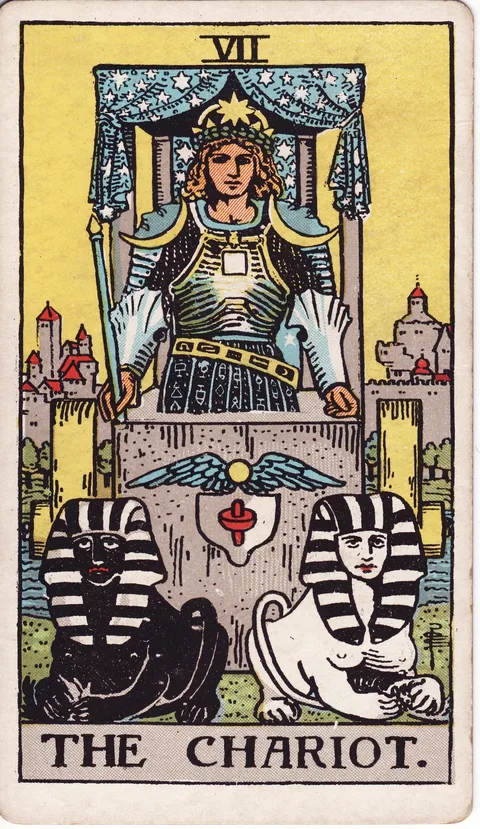 Inspect artwork
Upright meaning #
Upright, define the objective and decide which competing impulses need coordination. Progress may require a boundary, a schedule or a clear choice of priorities. The card emphasizes directed effort rather than the raw beginning represented by the Fool.
Reversed interpretation #
Reversed, consider loss of direction, excessive force or movement that looks impressive but serves no clear purpose. Pausing to reassess can be more useful than accelerating. The reversal does not predict a transport accident or prove that a journey will fail.
RWS imagery and symbolism #
An armored charioteer stands above two differently colored sphinxes. There are no ordinary reins in view, drawing attention to the problem of steering. The canopy and city behind suggest a defined position from which the figure moves outward.
A contextual reading example #
Facing several deadlines, a reader draws the Chariot in the action position. A useful interpretation is to choose the essential task, arrange the others around it and state what cannot be done simultaneously. It is not a command to ignore exhaustion or other people’s needs in pursuit of victory.
Distinctions and limits #
The Chariot is VII and corresponds to Cancer in the Golden Dawn scheme. That association belongs to a particular esoteric system; it does not turn Cancer into a universally forceful personality type or equate the card with Life Path 7.
ACROSS TRADITIONS
Explore the connections
Optional correspondences within named systems. Each connection has its own context and source.
- numerology · Optional numerical readingNumber 7 →
The printed number is VII, or 7. Numerological approaches to tarot can add this general number vocabulary to the image. An original reflection prompt here is the discipline needed to direct competing pulls. This is not a Life Path calculation.
Modern numerological tarot; RWS numbering · Source
Sources & editorial notes
Original explanations and hypothetical examples prepared with AI assistance for Synergy. Sources document the traditions described; they do not establish predictive or causal validity.
Rider–Waite–Smith artwork by Pamela Colman Smith, public domain. Images are resized historical scans from Wikimedia Commons; the full card images retain their borders and original coloring. Image sources and credits.
- A. E. Waite, The Pictorial Key to the Tarot (1911), illustrated by Pamela Colman Smith
Part II, this card’s imagery; compare Part III for historical divinatory meanings. The reflective upright, reversal and reading examples here are original modern interpretations, not quotations from Waite.
Related tarot reading

Put it into practice
The daily reading uses 22 Major Arcana cards. A draw is not guaranteed to include the card you are studying.
Try Synergy’s daily one-card reading (Major Arcana only) →