On this page
AT A GLANCE
The Five of Cups concerns disappointment or loss that deserves acknowledgment. It also asks what remains available once attention can widen. The remaining cups do not cancel the loss; they represent a different question that may become useful in time.
Explore all 78 tarot cards →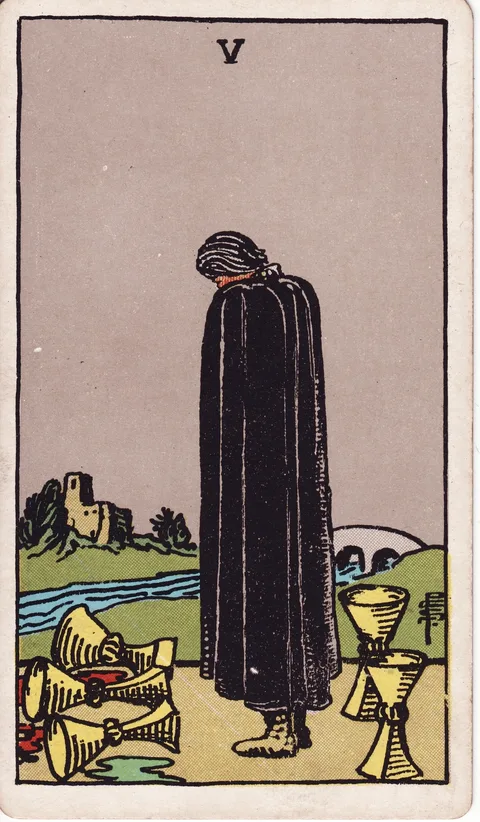 Inspect artwork
Upright meaning #
Upright, name what has been lost rather than rushing into reassurance. Grief can coexist with continuing relationships or resources. The card may invite a gradual shift from the unavailable outcome toward what can still be cared for.
Reversed interpretation #
Reversed, consider beginning to reconnect, accepting support or finding that an old disappointment still shapes current expectations. It does not set a timetable for recovery. A useful reading respects the actual scale of the loss and the person’s pace.
RWS imagery and symbolism #
A cloaked figure looks toward three fallen cups while two remain standing behind. A bridge and building lie across the water. The composition directs attention toward loss first, with remaining possibilities outside the figure’s immediate gaze.
A contextual reading example #
After a rejected application, a reader draws the Five in the situation position. It could acknowledge disappointment and, when ready, prompt reviewing feedback and other options. It would not imply that the rejection was necessary for a better fate or that sadness should end immediately.
Distinctions and limits #
The card cannot predict bereavement or diagnose a mood disorder. Its Golden Dawn assignment is Mars in Scorpio. ‘Look at what remains’ is a possible next inquiry, not a command to minimize what mattered.
ACROSS TRADITIONS
Explore the connections
Optional correspondences within named systems. Each connection has its own context and source.
Sources & editorial notes
Original explanations and hypothetical examples prepared with AI assistance for Synergy. Sources document the traditions described; they do not establish predictive or causal validity.
Rider–Waite–Smith artwork by Pamela Colman Smith, public domain. Images are resized historical scans from Wikimedia Commons; the full card images retain their borders and original coloring. Image sources and credits.
- A. E. Waite, The Pictorial Key to the Tarot (1911), illustrated by Pamela Colman Smith
Part III, Five of Cups: imagery and historical divinatory meanings. Contextual examples and reversal options are original modern reflective interpretations; historical gender stereotypes and predictive claims are not adopted.
Related tarot reading

Put it into practice
The daily reading uses 22 Major Arcana cards. A draw is not guaranteed to include the card you are studying.
Try Synergy’s daily one-card reading (Major Arcana only) →