On this page
AT A GLANCE
The Empress concerns conditions that allow something to grow: care, nourishment, creativity and an engaged relationship with the senses. Abundance here can mean enough time and attention, not only material plenty. The card is not a reliable pregnancy indicator.
Explore all 78 tarot cards →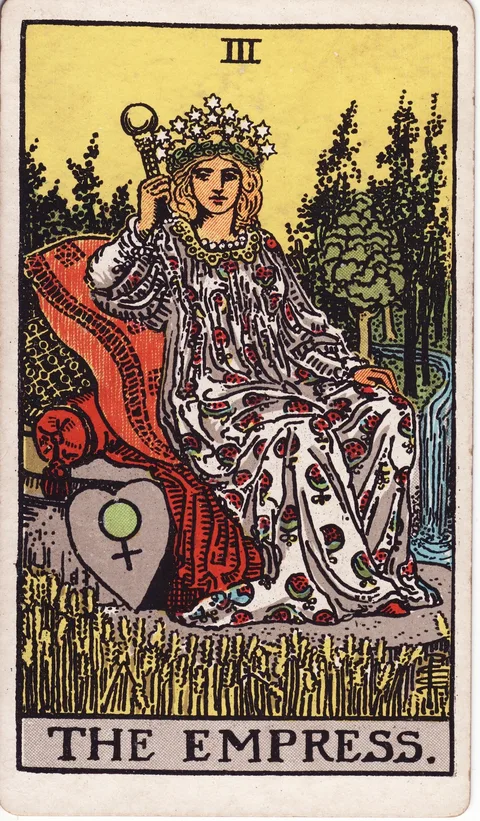 Inspect artwork
Upright meaning #
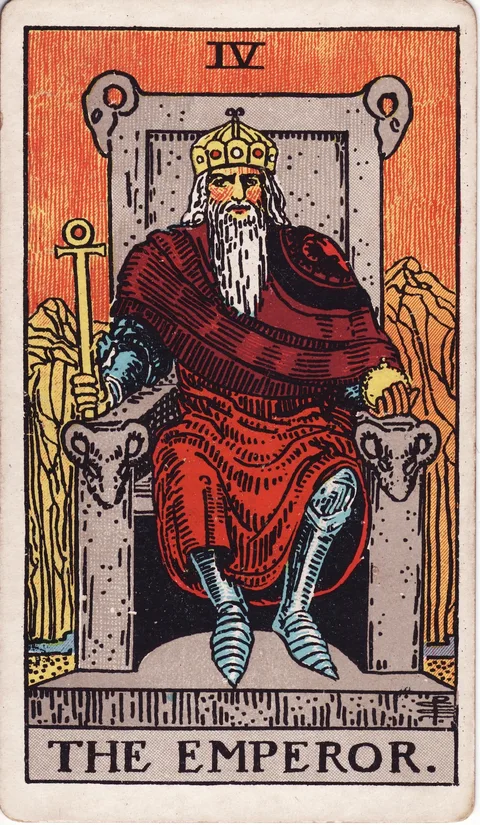
Upright, ask what needs tending rather than forcing. A project may need regular care, a relationship more enjoyment, or an exhausted person practical support. The Empress differs from the Emperor’s structural emphasis by foregrounding the living experience within a structure.
Reversed interpretation #
Reversed, consider neglected needs, overgiving or growth constrained by unrealistic expectations. It can also prompt reassessing what you call abundance when maintaining it leaves you depleted. Avoid treating the reversal as a judgment about femininity, caregiving ability or fertility.
RWS imagery and symbolism #
The seated figure appears among grain, trees and flowing water, with a starry crown and a shield bearing Venus’s symbol. The picture presents cultivation and enjoyment together. Its fertility imagery supports a broad reading of creation, while bodily reproduction is only one historical association.
A contextual reading example #
In a reading about a community garden, the Empress as an action card could point to improving soil and making participation welcoming before expanding the site. In a relationship question, it may ask how care is experienced by the recipient, rather than how impressive the gesture looks.
Distinctions and limits #
Care is not control, and nurturance need not be gendered. A card cannot diagnose reproductive health or guarantee prosperity. The Venus correspondence is a named Golden Dawn attribution; it does not mean that every Venus placement produces Empress-like behavior.
ACROSS TRADITIONS
Explore the connections
Optional correspondences within named systems. Each connection has its own context and source.
- numerology · Optional numerical readingNumber 3 →
The printed number is III, or 3. Numerological approaches to tarot can add this general number vocabulary to the image. An original reflection prompt here is development given practical support. This is not a Life Path calculation.
Modern numerological tarot; RWS numbering · Source
Sources & editorial notes
Original explanations and hypothetical examples prepared with AI assistance for Synergy. Sources document the traditions described; they do not establish predictive or causal validity.
Rider–Waite–Smith artwork by Pamela Colman Smith, public domain. Images are resized historical scans from Wikimedia Commons; the full card images retain their borders and original coloring. Image sources and credits.
- A. E. Waite, The Pictorial Key to the Tarot (1911), illustrated by Pamela Colman Smith
Part II, this card’s imagery; compare Part III for historical divinatory meanings. The reflective upright, reversal and reading examples here are original modern interpretations, not quotations from Waite.
Related tarot reading

Put it into practice
The daily reading uses 22 Major Arcana cards. A draw is not guaranteed to include the card you are studying.
Try Synergy’s daily one-card reading (Major Arcana only) →