On this page
AT A GLANCE
The World concerns completion that brings parts into a coherent whole. It can mark reaching a threshold, integrating an experience or recognizing how a contribution fits a wider context. Completion does not mean that all future work or difficulty has ended.
Explore all 78 tarot cards →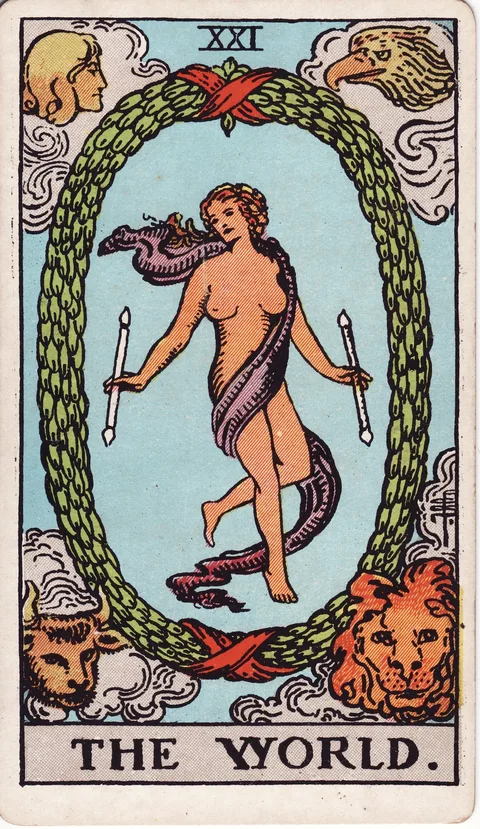 Inspect artwork
Upright meaning #
Upright, identify what has actually been accomplished and what makes it whole enough to stand on its own. The task may be a handover, a celebration or applying learning beyond its original setting. The card differs from the Wheel’s changing conditions by emphasizing integration.
Reversed interpretation #
Reversed, consider an unfinished final step, difficulty recognizing completion or a result whose parts do not yet fit together. Ask what is specifically missing. Endless refinement can prevent a valid ending just as easily as rushing past an essential requirement.
RWS imagery and symbolism #
Smith places a dancing figure within a wreath, with four symbolic beings in the corners. The frame gathers the image into a whole while the dancer remains in motion. This supports completion as a living relationship among parts rather than a frozen state of perfection.
A contextual reading example #
After completing a course, the World in an advice position could suggest assembling the work, acknowledging what was learned and deciding how to use it outside the classroom. It does not promise that the qualification will solve every career question.
Distinctions and limits #
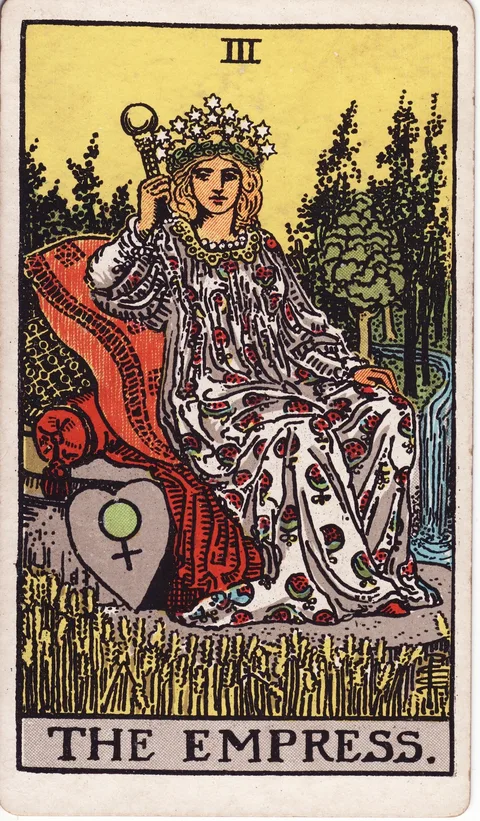
The card is XXI in RWS. Golden Dawn’s Universe/World attribution includes Saturn and Earth. A reduced reading explicitly calculates 2 + 1 = 3; that numerical layer does not make the World identical to the Empress or determine a Life Path.
ACROSS TRADITIONS
Explore the connections
Optional correspondences within named systems. Each connection has its own context and source.
Sources & editorial notes
Original explanations and hypothetical examples prepared with AI assistance for Synergy. Sources document the traditions described; they do not establish predictive or causal validity.
Rider–Waite–Smith artwork by Pamela Colman Smith, public domain. Images are resized historical scans from Wikimedia Commons; the full card images retain their borders and original coloring. Image sources and credits.
- A. E. Waite, The Pictorial Key to the Tarot (1911), illustrated by Pamela Colman Smith
Part II, this card’s imagery; compare Part III for historical divinatory meanings. Upright and reversed examples here are original reflective interpretations, not a transcription of Waite’s fortune-telling rules.
Related tarot reading

Put it into practice
The daily reading uses 22 Major Arcana cards. A draw is not guaranteed to include the card you are studying.
Try Synergy’s daily one-card reading (Major Arcana only) →