On this page
AT A GLANCE
Temperance concerns combining different elements into a workable relationship. It suggests adjustment, patience and an attentive sense of proportion. Balance is an ongoing practice here, not necessarily a compromise halfway between two equally good choices.
Explore all 78 tarot cards →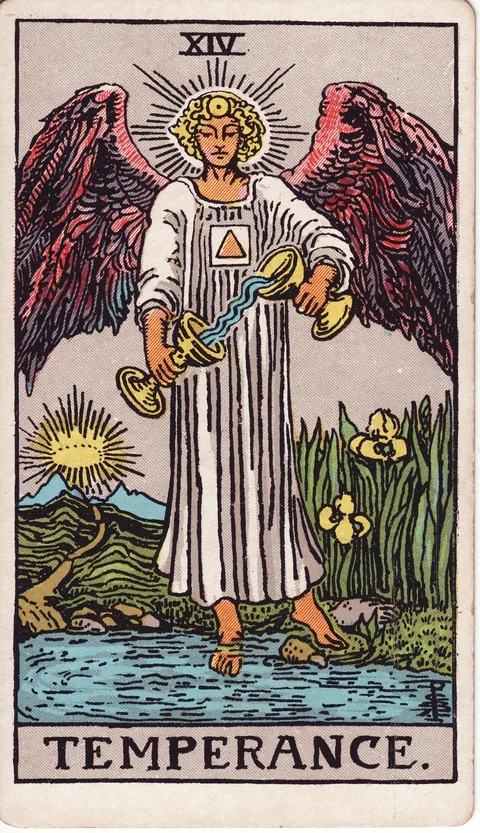 Inspect artwork
Upright meaning #
Upright, make small changes and observe how they interact. The task may be integrating a new routine, coordinating different working styles or allowing time for an idea to settle. It differs from Justice’s assessment by focusing on the process of blending and calibration.
Reversed interpretation #
Reversed, consider excess, competing demands or a mixture whose parts do not currently support one another. The response may be reducing one demand or separating tasks before trying to combine them. It does not diagnose a substance problem or a medical imbalance.
RWS imagery and symbolism #
Smith’s winged figure pours liquid between two cups, with one foot on land and one in water. A path leads toward a distant light. The image holds different conditions together and emphasizes a process that needs attention, not a static symbol of perfect calm.
A contextual reading example #
Two colleagues have different planning styles. Temperance in an advice position could suggest a short shared check-in plus enough independent time for each to work well. The example is a negotiated arrangement whose effectiveness can be observed and revised.
Distinctions and limits #
The card is XIV. Reducing 1 + 4 to 5 is an optional numerical method, not a replacement for the image. Golden Dawn associates Temperance with Sagittarius. Moderation does not mean tolerating an unsafe situation or treating every disagreement as equally valid on both sides.
ACROSS TRADITIONS
Explore the connections
Optional correspondences within named systems. Each connection has its own context and source.
- astrology · Zodiac attributionSagittarius →
Book T assigns Temperance to Sagittarius. This is a specific esoteric tarot attribution, not a claim that the card describes everyone with this placement.
Golden Dawn / Book T · Source
Sources & editorial notes
Original explanations and hypothetical examples prepared with AI assistance for Synergy. Sources document the traditions described; they do not establish predictive or causal validity.
Rider–Waite–Smith artwork by Pamela Colman Smith, public domain. Images are resized historical scans from Wikimedia Commons; the full card images retain their borders and original coloring. Image sources and credits.
- A. E. Waite, The Pictorial Key to the Tarot (1911), illustrated by Pamela Colman Smith
Part II, this card’s imagery; compare Part III for historical divinatory meanings. Upright and reversed examples here are original reflective interpretations, not a transcription of Waite’s fortune-telling rules.
Related tarot reading

Put it into practice
The daily reading uses 22 Major Arcana cards. A draw is not guaranteed to include the card you are studying.
Try Synergy’s daily one-card reading (Major Arcana only) →