On this page
AT A GLANCE
The Queen of Cups concerns holding emotional experience with attention and care. It can suggest compassionate listening, imaginative depth or a need to understand one’s own responses. Empathy is a practice, not proof that an impression about someone else is correct.
Explore all 78 tarot cards →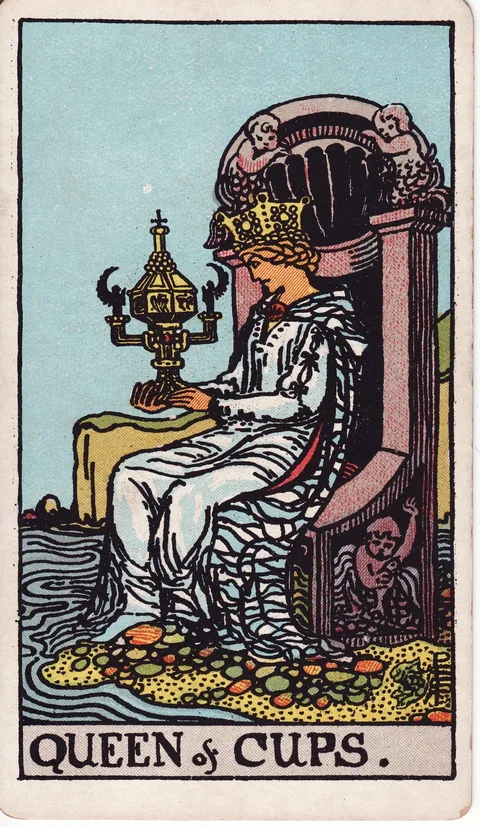 Inspect artwork
Upright meaning #
Upright, listen without immediately fixing or absorbing the problem. The Queen can model a container for feeling: enough space to acknowledge it and enough boundary to remain responsive. Artistic or reflective work may also benefit from this attentive stance.
Reversed interpretation #
Reversed, consider emotional overextension, unclear boundaries or difficulty distinguishing your response from another person’s needs. It may ask for support or private reflection. The card should not diagnose someone as unstable or excessively sensitive.
RWS imagery and symbolism #
Smith’s queen sits beside water and studies an ornate, closed cup. The cup’s distinctive form makes inward attention central. Her position near the water suggests engagement with feeling while still occupying a defined seat.
A contextual reading example #
A friend brings a difficult concern, and the Queen appears as advice. A useful response is to ask what kind of support is wanted and listen carefully, while recognizing what you cannot provide. Taking over the decision would be different from caring.
Distinctions and limits #
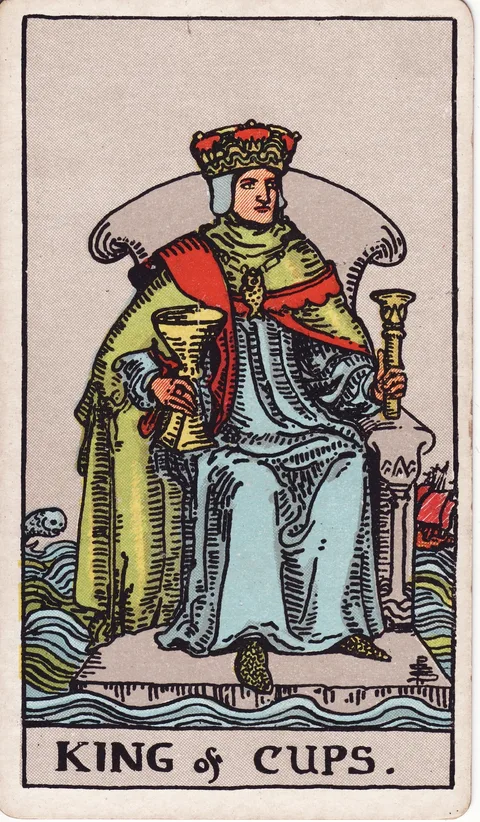
The Queen is not a gender requirement or a license to read minds. Its reflective quality differs from the King of Cups’ emphasis on maintaining steadiness while carrying broader responsibility.
Sources & editorial notes
Original explanations and hypothetical examples prepared with AI assistance for Synergy. Sources document the traditions described; they do not establish predictive or causal validity.
Rider–Waite–Smith artwork by Pamela Colman Smith, public domain. Images are resized historical scans from Wikimedia Commons; the full card images retain their borders and original coloring. Image sources and credits.
- A. E. Waite, The Pictorial Key to the Tarot (1911), illustrated by Pamela Colman Smith
Part III, Queen of Cups: imagery and historical divinatory meanings. Contextual examples and reversal options are original modern reflective interpretations; historical gender stereotypes and predictive claims are not adopted.
Related tarot reading

Put it into practice
The daily reading uses 22 Major Arcana cards. A draw is not guaranteed to include the card you are studying.
Try Synergy’s daily one-card reading (Major Arcana only) →